The Missing Curriculum
The polycrisis is not a list: climate · attention · inequality · institutional decay · AI risk · mental-health collapse — all at once
System-wide and simultaneous failure = the diagnostic signature of an OS pathology, not an application bug
The OS was specified in the 19th century, formalised in the 20th, is failing under 21st-century loads
What we will do in the next 90 minutes — name the diagnosis, give you the vocabulary, point at the architecture
The trap, not the trapped
Reflex: blame the people — greedy CEOs, captured regulators, distracted citizens, opaque algorithms
Sharper: look at the field of incentives the people operate inside
"Capable, well-intentioned people can be the principal producers of a system's worst outcomes — because the field selects for outcomes, not for intentions."
Hold this all session — we are looking at a trap, not at the people inside it
Coordination failure as physics
The prisoner's dilemma — game theory, 1950, RAND. Rational individual choice, collective worse outcome
The multipolar trap — scale it up: fisherman, social network, country with labour laws. Same logic.
Moloch — Ginsberg 1955 → Scott Alexander 2014. The personification of coordination failure as a force
Tragedy of the commons — Hardin 1968 (and why Hardin was empirically wrong)
Ostrom — Nobel 2009, eight design principles, the most rigorous science of Moloch-resistant institutions
Goodhart's Law — "when a measure becomes a target, it ceases to be a good measure"
Test scores stop measuring learning. GDP stops measuring welfare. Engagement metrics stop measuring satisfaction.
This is the trap. Now: what kind of trap is it?
Technology is not neutral
Heidegger 1954 — Gestell, modern tech orients us so everything reveals itself as standing-reserve
Forest = lumber-in-waiting. River = hydroelectric potential. Human = human capital.
Ellul 1954 — la technique: a self-reinforcing logic of efficiency that subordinates politics, ethics, culture
Ellul 1962 — Propaganda: the manufactured cognitive substrate technique requires to operate at scale
Postman 1992 — Technopoly: the surrender of culture itself to the technological frame
Yuk Hui 2016 — cosmotechnics: there is no universal "technology"; every civilisation grows technics embedded in its cosmology
That mistake is the door Half B walks through
Markets are not neutral
Polanyi 1944 — modernity forced labour, land, money to behave as commodities they aren't → disembedding
Planned obsolescence lineage — London 1932 → Stevens 1954 → Packard 1960 — manufactured desire as industrial doctrine
Graeber's Debt (2011) — barter is a myth. Debt-as-relation predates money. Ancient civilisations had jubilees.
Debt as obligation, not transaction. Bridge to Ṛṇa in Half B.
Graeber's Bullshit Jobs — managerial feudalism in capitalism's clothes; the lived experience inside the trap
Doctorow — enshittification: good to users → good to business → good to shareholders → dead
Markets constitute what counts as a good, a person, a relation. The constitution is increasingly hostile to what makes life valuable.
Attention, cognition, planetary substrate
McGilchrist 2009 — the right hemisphere has been captured by the left; the emissary has captured the master
Moloch = unchecked left-hemisphere optimisation at civilisational scale
Han 2010 — the achievement-subject who exploits himself voluntarily; burnout and depression as systemic outputs, not personal failures
Rockström — nine planetary boundaries, several already crossed
Raworth's Doughnut — social floor + ecological ceiling; the most operational existing alternative to GDP-growth
The closest Western parallel to the embedded-economy mandala we reach in Half B
One upstream, many crises
Schmachtenberger — climate, AI, biorisk, mental-health, institutional decay are symptoms of one upstream generator function
Generator function = exponential tech × Molochian incentives × captured sensemaking × finite biosphere
Tainter 1988 — same diagnosis with archaeology and a 12,000-year dataset; marginal returns on complexity go negative → adaptive simplification
Conway Debt (deck, slide 3) — Melvin Conway's Law × John Conway's Game of Life. "The skeuomorphic hangover of past decisions, organisational topologies, and techno-memetic ontologies."
The metacrisis = planetary-scale Conway Debt come due
"The economy is not a machine. It is an evolving ecosystem driven far from equilibrium by persistent energy inputs."— Sanyal
"How does society represent the energy that drives it out of equilibrium? All signs kind of started to point to money."— Buchman
The substrate question is a metaphysics question, not just a physics one. Half B is the longer answer.
Metaphysics chooses institutional topology
Every civilisation runs on a metastory — an implicit cosmic narrative
Selfish Gene (Hobbes → Darwin → Dawkins) — competition default; cooperation fragile; entropy wins; extractive institutions rational
→ Moloch is the predictable downstream signature
Dhārmika Gene (Pandey, on Brhat) — Ṛta is default; rhythm precedes rupture; coordination is the substrate from which temporary extraction departs
What memes, what institutions, what economics would have grown if we had been running on the Dhārmika story instead of the Selfish one?
Half B is the operational answer
The rediscovery thesis
150 years of fragmented Western disciplines — cybernetics, ecology, complexity science, anthropology, phenomenology, feminist STS — converge on the same picture
The classical Indic darśanas held that picture as one unified frame
The diagnostic layer is now sharp; the integrative darśana is what's missing
Half B is the integrative frame, in its own language, made operational
Yathā Piṇḍe Tathā Brahmāṇḍe
As in the small body (piṇḍa), so in the cosmos (brahmāṇḍa).
Not metaphor. An information-theoretic claim about the deep structure of reality.
21st-century vocabulary — high-dimensional fractal cellular automaton of complex adaptive systems (Conway → Wolfram)
Wolfram 2020 — the Ruliad — the abstract object containing every possible rule applied to every initial state, computed forward forever
Codex synthesis: what the embodied observer — the Ātman — experiences is a low-dimensional projection of the Ruliad, from a specific viewpoint
Architecture and cosmos are legible from each other. Hold this lightly through Half B.
Indic systems thinking
Meadows (2008) — every system is elements, interconnections, and purpose
The Indic frame — Kṣetra · Karma · Kula — adds space, time, and identity into how a system evolves
Kṣetra (क्षेत्र) — the field. Substrate. Boundary conditions. Inheritance. Root Ṛ (motion, rising). Contemporary: computational irreducibility, autonomous eco-systems
Karma (कर्म) — action-in-rhythm. Dynamics. Flow. Causality. Feedback. Root Ṛta (gati, the attainment of motion). Contemporary: resonance, adaptive emergence, chaos theory
Kula (कुल) — community of belonging. Lineage. The moral fabric carrying obligation through time. Root Ṛṇa (debt, obligation; "no write-off in Ṛṇa"). Contemporary: regulation, simple heuristics producing complex order, cellular automata
The Kṣetra defines a system's limits; the Karma defines its rhythms; the Kula defines its purpose.
The same triad reads at every scale — body, household, firm, village, civilisation, planet. Yathā piṇḍe tathā brahmāṇḍe.
the original Kṣetrapāla entrusts the contemporary Kṣetrapālas (forest officers, the modern state) with the duty of caring for place and people
When the contemporary Kṣetrapāla forgets dharma, when guardianship turns extractive — imbalance follows
The architecture made teachable
Pañca Ṛṇa — five obligations
Bhūta Ṛṇa — to the earth, elements, beings · ecological substrate
Manuṣya Ṛṇa — to fellow humans, to society · social substrate
Pitṛ Ṛṇa — to lineage, ancestors, household · Kula // Household // Labour
Ṛṣi Ṛṇa — to wisdom-streams, sages, knowledge inheritance · Karma // Markets // Capital
Dev Ṛṇa — to the inherited estate, land, gods of place · Kṣetra // Estate // Land
"There is no write-off in Ṛṇa."— primer
Climate breakdown = Bhūta Ṛṇa coming due. Mental-health collapse = Manuṣya / Pitṛ coming due. The attention economy = Ṛṣi coming due.
Why this is structurally harder to Goodhart than GDP — three reasons
(1) Relational, not numerical — each ṛṇa names specific counterparties
(2) Non-fungible — gaming one ledger does not cover the other four
(3) Named violations register — breach reads as moral failure, not as clever optimisation
Not un-gameable. Harder to game silently. That is the structural improvement over GDP.
The synthesis
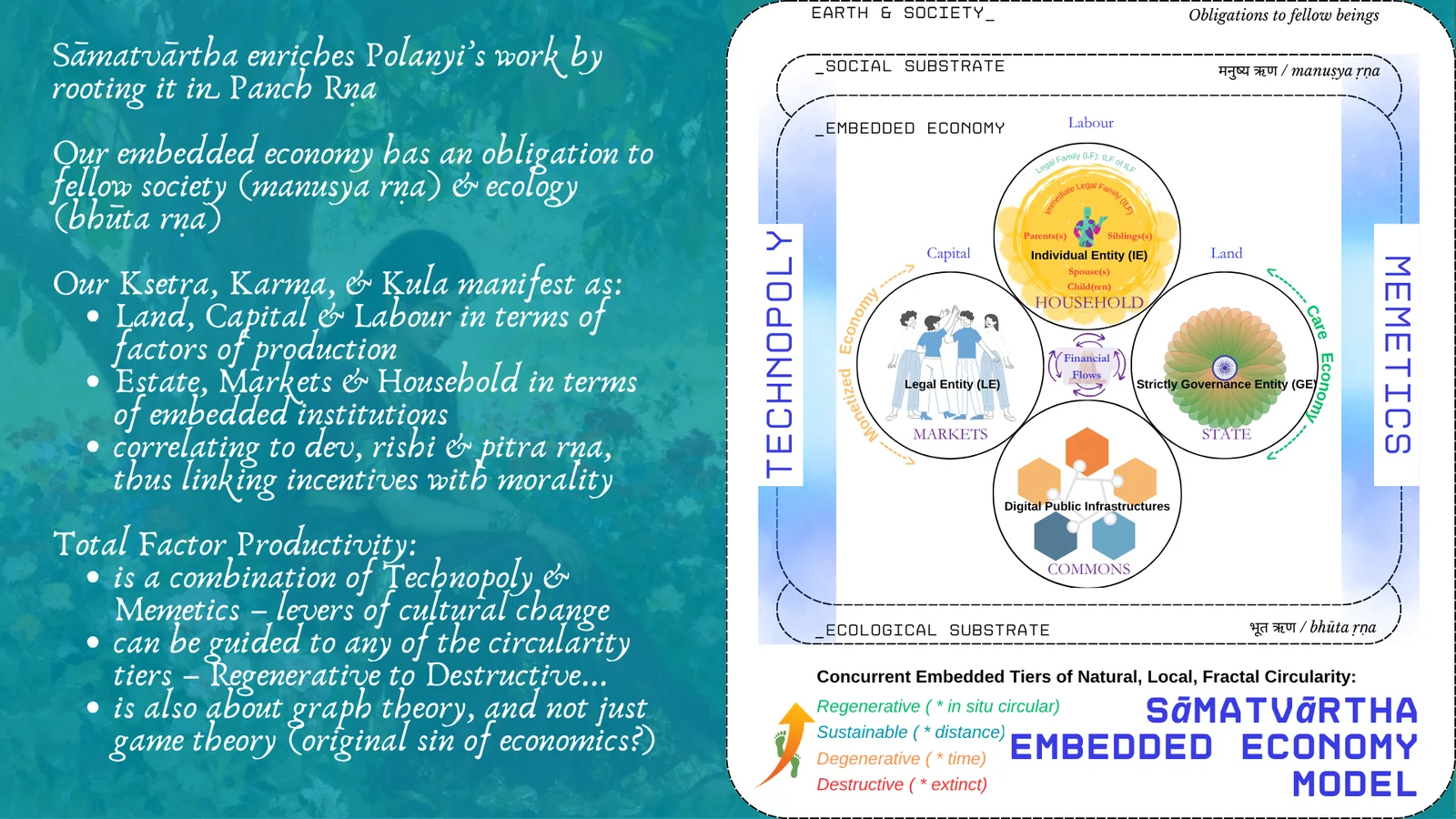
Concentric tiers — Ecological substrate (Bhūta) outermost
→ Social substrate (Manuṣya) within it
→ Embedded economic substrate inside — three forms: Estate · Markets · Household ↔ Dev · Ṛṣi · Pitṛ ↔ Land · Capital · Labour
Two pillars frame the structure — Technopoly (Postman) on one side, Memetics on the other
The architecture is deliberate about both. Not tech-neutral. Not story-neutral.
Cutting across — four circularity tiers — Regenerative · Sustainable · Degenerative · Destructive — the moral physics of every activity
Same direction as Raworth's Doughnut. Deeper substrate. The Doughnut is a 2-axis safe operating space; the mandala adds a ledger of obligation, a spine of metaphysics, and named levers on either side.
This is the architecture. Now: what does it refuse, and what does it propose?
ReGrowth, not Degrowth
The frame refuses two binaries the Western debate keeps falling back into
Doomer or accelerationist on AI? Neither — same technology, different substrate, different audit
Unbounded growth or degrowth? Neither. Third attractor.
ReGrowth — a higher quality of growth that → restores what was depleted · regenerates what was lost · renews what is timeless
A memetic correction to degrowth's branding problem — with substantive content beyond the branding
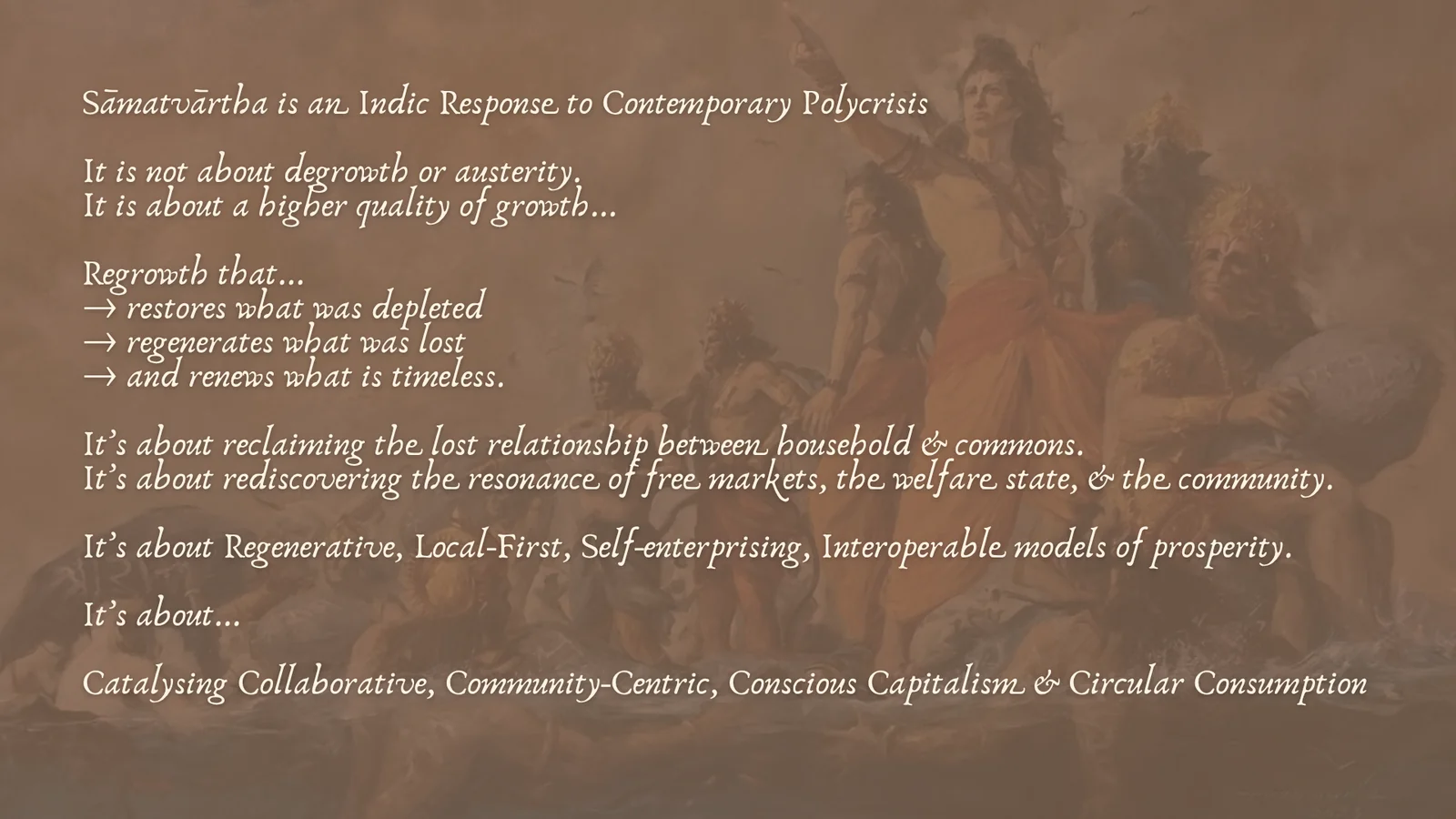
The phrase the deck carries throughout: Catalysing collaborative, community-centric, conscious capitalism, and circular consumption. Regenerative, local-first, self-enterprising, federated, interoperable.
The phrase reads like marketing. The architecture beneath is what makes it operational.
Your seat
If you are a student — your seat is not a job. It is a place in the architecture. A vocation, not a career.
If you are a teacher / faculty — your seat is the unblocker. The students arrive curious. The curriculum forecloses. The Codex is open-source.
If you are a builder, founder, policy person, or steward — your seat is the substrate itself. Every regulation, every product, every essay you ship either deepens the Pañca-Ṛṇa-aware substrate or further hollows it. Choose.
the longer 90-min session walks through this slowly. The Codex at 2014p.com/codex.html — twenty-plus cross-linked essays.
Thank you.
What gets built (optional)
The build is downstream of the architecture. Demoted from the core arc by design.
The orienting move is reclamation. Experience captured by markets and the state, returned to household, community, and commons — on contemporary technological rails.
the Techno-Memetic Commons (TMC)
Three vehicles operationalise it — Stack · Interchain · Network State
Sāmatvārtha Stack — state-side substrate · Policy Lab · administrative DPIs, public-policy process reforms
Sāmatvārtha Interchain — enterprise-side substrate · Venture Lab · local-first DPIs for nano-MSMEs and federations
Sāmatvārtha Network State — community-side substrate · Community Lab · charter zones, federated franchises, social fabric
AI cuts across all three — same technology, different substrate, different audit (see Codex essay AI is the Audit)