Sāmatvārtha Sessions · The Missing Curriculum
A 90-minute bootcamp on contemporary sensemaking, with an Indic synthesis
v0.2 · May 2026 · evolving thesis, open to feedback
The Western critical canon has been writing the same diagnosis in fragments for 150 years. One Indic frame held the same diagnosis as a single unified architecture much earlier. This session puts them in the same room, walks the diagnosis, then closes on the architecture.
Formats. 15-min trailer · 45-min single-slot lecture · 90-min full bootcamp (also runnable as 2 × 45 across two sessions). Speaker delivers in English; Sanskrit terms introduced and translated as we go. No prior reading required.
PART I — For institutions considering hosting
Why this matters now
Indian universities, schools, and policy classrooms are still teaching a 19th-century operating system — neoclassical economics, mechanistic management, separated disciplines — at the exact moment that operating system is visibly failing on planetary scale. The "polycrisis" — climate, attention, inequality, AI risk, institutional decay — is not a list of separate problems. It is the predicted output of a single mis-shaped substrate. The contemporary Western critical canon (Schmachtenberger, Raworth, Ostrom, McGilchrist, Doctorow, and a long lineage behind them) has been naming this in fragments for fifty years. The Indic darśana tradition had a coherent unified frame for it long before — but the colonial-academic transmission pattern flattened that frame into "culture" or "religion" and stripped its operational content.
This bootcamp is the bridge. One session, twenty named thinkers from the West, one architecture from the Indic frame, one synthesis your students will not get anywhere else in their curriculum.
What participants take away
By the end of the session, every participant — regardless of discipline — will be able to:
- Name the diagnosis — articulate why "people are doing locally rational things that aggregate into collectively worse outcomes" is the master pattern, using Moloch, Goodhart's Law, and Conway Debt as working vocabulary
- Read the substrate, not the symptom — distinguish a crisis from a generator function, and resist the reflex of solving symptoms while the upstream pathology continues producing them
- Recognise the metastory — see how every civilisation runs on an implicit cosmic story (the Selfish Gene default vs. the Dhārmika Gene alternative), and how that story chooses institutional topology
- Hold the architecture — read the Ṛ → Ṛta → Ṛṇa spine, the Pañca Ṛṇa ledger, and the embedded-economy mandala as one coherent map, not five unrelated terms
- Locate themselves — find their own seat (student / teacher / builder / policy-maker) in the architecture and identify one move they can make from where they already are
Who it's for — the four hats, one room
The session is deliberately designed to land for all four archetypes in the same room. Each gets something different from the same body:
- Students — vocabulary for unease they already feel; permission to think at the paradigm level, not just the policy level; a reading list that opens a 150-year canon
- Faculty — a cross-disciplinary diagnostic that crosses economics, philosophy, computer science, ecology, and design; pedagogical ammunition for the slot they have been quietly wanting in their curriculum
- Curriculum decision-makers — coverage of contemporary critical theory + Indic darśana bridge, mappable to learning outcomes labelled interdisciplinary, critical thinking, ethics, sustainability, systems thinking
- Working practitioners and founders — a frame for why well-intentioned operational work keeps producing unintended consequences, and a substrate (Pañca-Ṛṇa-aware design) on which to build differently
The closing chapter gives each hat a one-sentence next move. Nobody leaves the room without a seat.
Format options
| Format | Length | Best for |
|---|---|---|
| Trailer | 15 min | Assembly slot, opening keynote of a longer event, recruitment for the full bootcamp |
| Primer | 45 min | Single guest-lecture slot in an existing course; can stand alone |
| Full bootcamp | 90 min | Dedicated workshop or two-day mini-module (or two back-to-back classes) |
| Self-paced | 6 × ~15 min | If hosted asynchronously on the institution's LMS or 2014p.com |
Speaker, hosting, logistics
The session is delivered by Nilesh Lahoty (2014P_ Venture Studio), the author of the underlying Sāmatvārtha thesis. No special equipment required beyond a projector and an audio line. Optimal room size 20–200; the deck is designed for both seminar-style discussion and lecture-hall delivery. We provide: speaker, slide deck, this handout (printable), reading list, and a one-page architecture cheat-sheet for participants to keep. No fee required for accredited educational institutions; if your institution covers travel and a token honorarium, that is sufficient. Contact: hello@2014p.com.
How to slot this in
The session can run as a guest module inside an existing course or as a standalone session — a dedicated workshop, a public lecture, a faculty development hour, an offsite keynote, a student-club programme. Most natural curriculum adjacencies:
- Economics / Sustainability — alongside ecological economics, behavioural economics, development studies, institutional economics, evolutionary economics, public choice, political economy
- Complexity sciences — alongside systems dynamics, agent-based modelling, network science, computational social science, evolutionary game theory, cellular automata and emergence
- Philosophy / Humanities — alongside critical theory, philosophy of technology, Indian philosophy, science and technology studies, philosophy of mind
- Engineering / Computer Science — alongside systems thinking, ethics of computing, technology and society, the digital commons, mechanism design
- Management / Strategy — alongside strategic foresight, ESG, complexity in management, organisational design, institutional economics
- Design / Architecture — alongside design philosophy, urbanism, regenerative design, social design
It is also delivery-shaped for an interdisciplinary lecture series, a leadership offsite, a faculty development program, or a public-intellectual visiting talk.
PART II — The course
The map at a glance — the diagram we will build up to
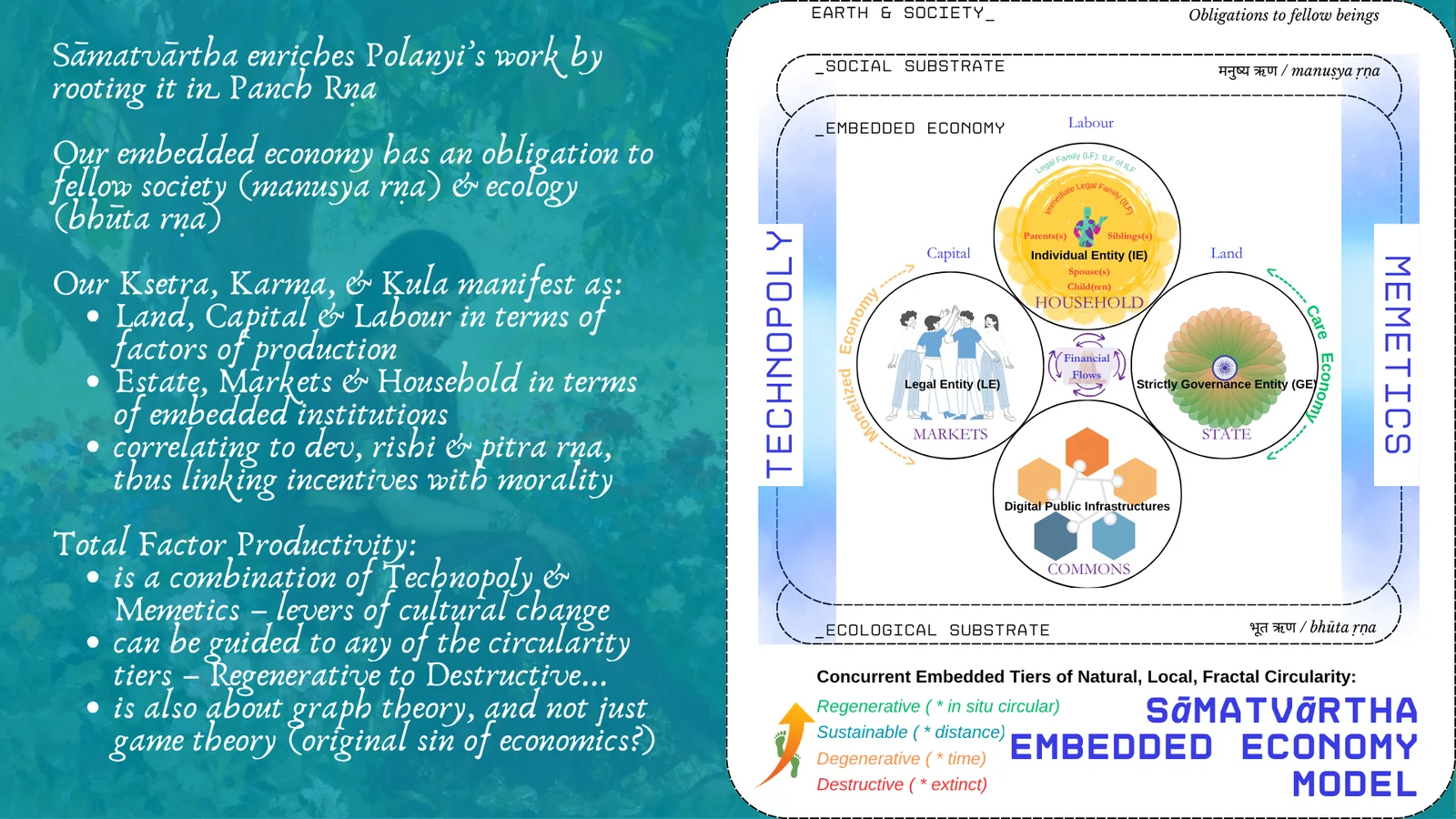
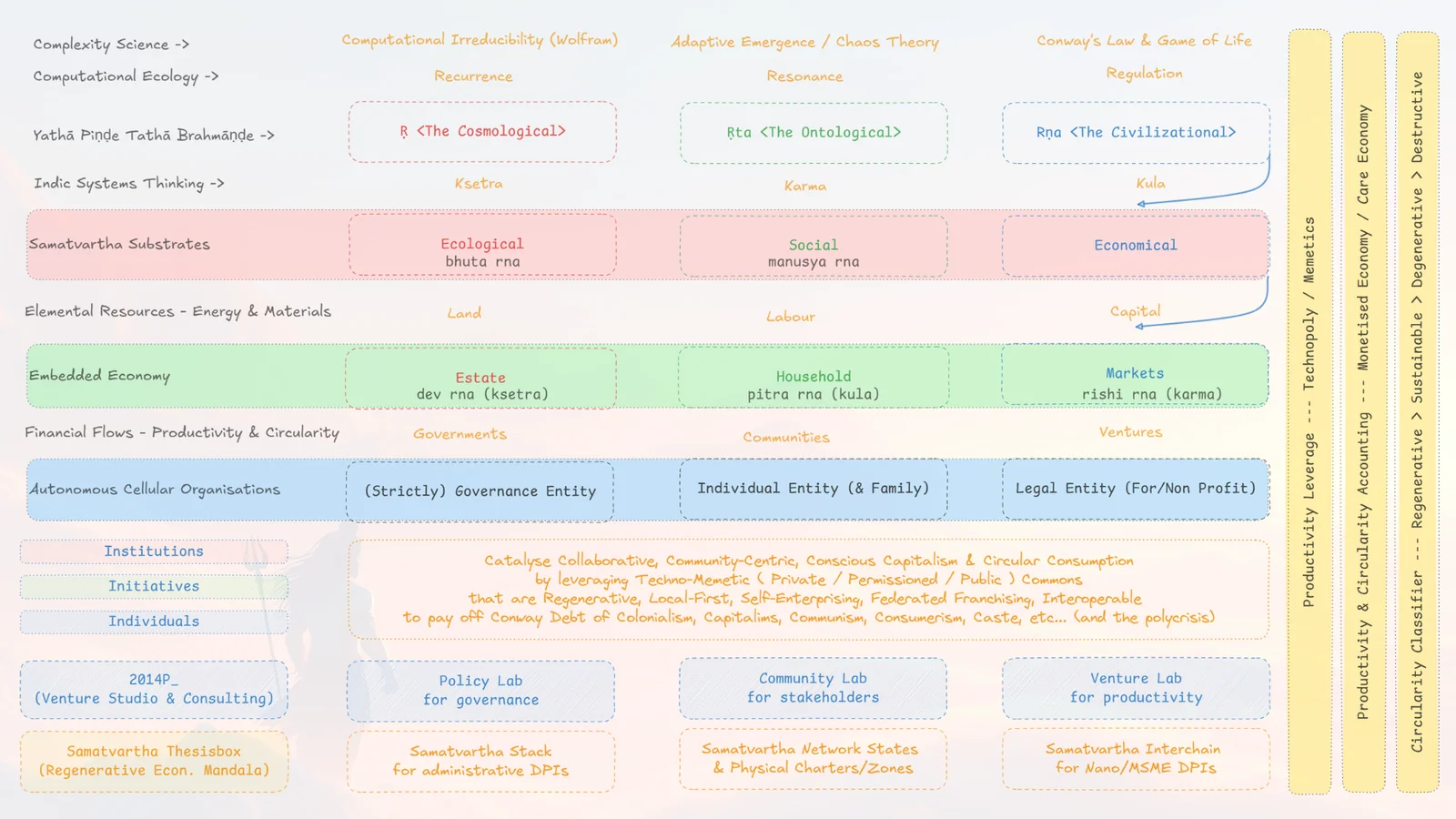
Optional opener: show this paragraph (or its visual, slide 21 of the deck) at the very start of the session and again at the end. Twenty Western thinkers feed in from one side; one Indic synthesis holds the diagram together on the other; complexity sciences supply the bridging vocabulary. Take a screenshot — the rest of the session is the unpacking.
Three concentric tiers, top-down. Ṛ (the cosmological substrate — recurrence, autonomous systems, computational irreducibility). Inside it, Ṛta (the ontological dynamics — order, rhythm, resonance, adaptive emergence). Inside that, Ṛṇa (the civilisational ledger — debt, obligation, regulation, complexity from simple heuristics).
Five obligations sit on the innermost tier — Pañca Ṛṇa: Bhūta (to the earth and elements), Manuṣya (to fellow humans), Pitṛ (to lineage and household), Ṛṣi (to wisdom-streams), Dev (to the inherited estate). These five debts map directly onto the embedded economic transformation the Sāmatvārtha thesis proposes — Bhūta into the ecological commons, Manuṣya into the social commons, Pitṛ into the household, Ṛṣi into the markets, Dev into the estate. Five debts, five sites of economic activity, one ledger.
Two levers operate across the whole stack — Technopoly and Memetics. Four circularity tiers locate every economic activity — Regenerative · Sustainable · Degenerative · Destructive. This is the embedded-economy mandala. The architecture, said in a paragraph.
Half A — The diagnosis you weren't taught (45 min)
A1 · Hook — our civilisation is running on obsolete code (5 min)
The opening claim is empirical, not rhetorical. The intellectual operating system your university taught you — Homo economicus, market equilibrium, growth-as-goal, disciplines-as-silos, technology-as-neutral — was specified in the 1870s, formalised in the 1950s, and is now visibly failing under the loads of the 2020s. The failure is not coming from any single sector. It is system-wide and simultaneous. That is the diagnostic signature of an OS pathology, not an application bug.
A2 · The trap, not the trapped (5 min)
Before naming any villain, refuse the easy reading. The reflex is to blame the people running things — captured regulators, distracted citizens, opaque algorithms, founders chasing the wrong metric. The substrate explanation is sharper. The pathology is not in the agents. It is in the field of incentives the agents operate inside. Capable, well-intentioned people in any given system can be the principal producers of its worst outcomes — because the field selects for the outcomes, not for the intentions. Hold this through the rest of the session: we are looking at a trap, not at the people inside it.
Key term — Substrate. The shared background structure (incentives, narratives, infrastructure, institutions) that determines what counts as a rational move from inside it. Change agents — outcomes look similar. Change the substrate — outcomes shift.
A3 · Coordination failure as physics (10 min)
The cleanest existing name for the trap is Moloch — coined by Allen Ginsberg in Howl (1955) as the industrial-civilisation god to whom we sacrifice what we love, and given a game-theoretic chassis by Scott Alexander in Meditations on Moloch (2014). Moloch is what you call any situation where rational individual action aggregates into collectively worse outcomes than coordination would produce. The fisherman who restrains his catch is undercut by the one who doesn't, so fish stocks collapse. The social network that doesn't optimise engagement loses users to the one that does, so attention gets shredded. The student who doesn't cram for the test loses to the one who does, so testing replaces learning. The mechanism behind all of this is the multipolar trap. The pattern was named earlier as the tragedy of the commons (Hardin, 1968), and empirically corrected by Elinor Ostrom, who showed (Nobel, 2009) that humans actually govern commons sustainably across thousands of documented cases — if and only if eight specific design principles are present. The exploit Moloch uses against every coordination mechanism is Goodhart's Law: when a measure becomes a target, it ceases to be a good measure. Test scores stop measuring learning, engagement metrics stop measuring satisfaction, GDP stops measuring welfare. Every regulation creates the surface for its own evasion.
Key term — Multipolar trap. Multiple agents, each better off defecting from cooperation, all worse off in aggregate when they all defect. Selection pressure removes the cooperators.
A4 · Technology is not neutral (5 min)
Martin Heidegger (1954) names Gestell — modern technology orients us so that everything reveals itself as standing-reserve, raw material awaiting deployment. The forest becomes lumber-in-waiting. The river becomes hydroelectric potential. The human becomes human capital. Jacques Ellul (The Technological Society, 1954) names the same condition as la technique — a self-reinforcing logic of efficiency that subordinates politics, ethics, and culture to its own continuation, regardless of human intent. Ellul's later Propaganda (1962) extends the diagnosis to the manufactured cognitive substrate technique requires to operate at scale. Neil Postman's Technopoly (1992) names the endgame: the surrender of culture itself to the technological frame, the moment when technology stops being a tool inside culture and becomes the frame culture is admitted into. Yuk Hui (2016) opens the door past all of this: there is no universal "technology"; every civilisation grows its own technics embedded in its cosmology. The Western framework has been mistaking its own technics for the human one. That mistake is the door Half B walks through.
A5 · Markets are not neutral (5 min)
Karl Polanyi (The Great Transformation, 1944) showed that the move that built modernity was forcing labour, land, and money to behave as ordinary commodities. They aren't, and the forcing produced what Polanyi called disembedding — the market detaches itself from social control and runs over the society it was supposed to serve. The planned-obsolescence lineage (London 1932 → Stevens 1954 → Packard 1960) made manufactured desire a public industrial doctrine: "instilling in the buyer the desire to own something a little newer, a little sooner than is necessary." David Graeber (Debt: The First 5,000 Years, 2011) corrects a foundational economic story: barter does not precede money; debt-as-relation predates both, and ancient civilisations had jubilees because they understood that unrepayable debts must periodically be released to keep society from rupture. This sets up the Indic move in Half B — Ṛṇa is not transactional debt but moral obligation, a category Western economics has been trying to recover from one side for two centuries. Graeber's Bullshit Jobs (2018) names the felt experience of working inside this substrate — managerial feudalism in capitalism's clothes. Cory Doctorow named the contemporary platform-decay pattern enshittification: good to users → good to business → good to shareholders → dead. Markets do not merely allocate goods; they constitute what counts as a good, a person, a relation. The constitution they have been imposing is increasingly hostile to what makes life valuable.
A6 · Attention, cognition, planetary substrate (8 min)
Three nested layers of damage. Iain McGilchrist (The Master and His Emissary, 2009) argues from neuroscience that Western civilisation has been systematically privileging left-hemisphere mode — narrow, instrumental, abstract — past the point where the broader, contextual, embodied right-hemisphere mode can correct it. The emissary has captured the master. Moloch is what unchecked left-hemisphere optimisation produces at civilisational scale. Byung-Chul Han (Burnout Society, 2010) shows the contemporary form: neoliberal power doesn't repress, it makes you the achievement-subject who exploits yourself voluntarily; depression and burnout are not personal failures, they are the systemic output. Beneath all of this sits the substrate itself. Johan Rockström and the Stockholm Resilience Centre defined nine planetary boundaries; several have already been crossed. Kate Raworth's Doughnut Economics (2017) reframes the economy as the space between a social floor (everyone's needs met) and an ecological ceiling (planetary boundaries not breached) — the most operational existing alternative to GDP-growth as goal, and the closest Western parallel to the embedded-economy mandala we will reach in Half B.
A7 · Generator function — one upstream, many crises (7 min)
By the late 2010s, Daniel Schmachtenberger and the metacrisis canon (Rowson, Stein) argued the move directly: stop treating climate, AI, biorisk, mental health, epistemic collapse, and institutional decay as a portfolio of separate problems. Treat them as symptoms of one upstream generator function — exponential technology × Molochian incentives × captured sensemaking × finite biosphere. Joseph Tainter (Collapse of Complex Societies, 1988) is the same diagnosis with archaeology and a 12,000-year dataset: societies rise by adding complexity, each new layer costs more and solves less, marginal returns go negative, then comes adaptive simplification.
The Indic working name for this same pathology — sharper because it is operational — is Conway Debt: Melvin Conway's Law (organisations design systems mirroring their own communication structures) layered against John Conway's Game of Life (simple rules compounding into immense persistent complexity). Every org chart is a snapshot of conditions that no longer hold; stacked on itself for decades, the residue compounds like gliders that won't stop. The contemporary subcontinental version carries layered residues from each prior civilisational settlement — colonial-administrative, industrial-extractive, planned-economy, consumer-marketing, caste-as-frozen-by-census — each still computing in our institutions today. The metacrisis, in this vocabulary, is the planetary-scale Conway Debt come due.
One forward note before we pivot to Half B. The same direction Half B walks is already being reached for from the Western side, by people coming at economics from physics and computation rather than from neoclassical training. In the 15-minute primer video that accompanies this thesis, Sanjeev Sanyal reframes economics from machine to evolving ecosystem — "driven far from equilibrium by persistent energy inputs." Ethan Buchman carries the move further: sustainability is a stationary non-equilibrium state, the way the body's homeostasis is. What economics has been missing, Buchman argues, is the deep coupling between energy and information theory — "how does society represent the energy that drives it out of equilibrium?" His investigation, he says, "kind of started to point to money and the monetary system." This is exactly the doorway. Western thought, at the edge, is now asking the substrate question. Half B is the longer answer — because the substrate question, once taken seriously, turns out to be a metaphysics question, not just a physics one.
The pivot — Selfish Gene vs. Dhārmika Gene
The move from Half A to Half B turns on one sentence: metaphysics chooses institutional topology.
Every civilisation runs on a metastory — an implicit cosmic narrative about what the universe is and what it wants. The dominant Western metastory, from Hobbes through Darwin through Dawkins, is the Selfish Gene: competition is default, cooperation is fragile, the universe trends toward entropy, extractive institutions are the rational output. Moloch is the predictable downstream signature of running this metastory at civilisational scale.
The Indic metastory — given its sharpest contemporary articulation in Amritanshu Pandey's Dhārmika Gene essay (Brhat / Bodha Research) — names the alternative: Ṛta is default. Rhythm precedes rupture. Coordination is the substrate from which temporary extraction departs. Pandey reads the Sanskrit as load-bearing, not decorative: Sat (existence-with-equilibrium) and Ṛta (motion, becoming) together compose reality; Dhvamsana (entropic disintegration) is real but is met by Dhāraṇa (the tethering against dissolution); Dharma is literally dhṛ + man — the intentional ascent toward resilience through mind; Prāṇa (pra + an, "filled with breathing") names the cyclical principle that holds across scale — Yathā piṇḍe tathā brahmāṇḍe, as in the small body, so in the cosmos.
The question the session asks here, after Pandey: what memes, what institutions, what economics would have grown if our civilisation had been running on the Dhārmika Gene metastory instead of the Selfish Gene? Half B is the operational answer.
Half B — The architecture that was already here (45 min)
B1 · Reopen — the rediscovery thesis (3 min)
Stake the claim. The West has spent 150 years rediscovering, in fragmented disciplines — cybernetics, ecology, complexity science, anthropology, phenomenology, feminist science studies — pieces of what the classical Indic darśanas treated as a single unified ontology. The diagnostic layer is now sharp. The integrative darśana — a coherent civilisational frame from which an operational response derives rather than being assembled piecewise — is what remains missing in the Western corpus. The remainder of the session is that frame, named in its own language and made operational.
B2 · Yathā Piṇḍe Tathā Brahmāṇḍe — the fractal cosmology (4 min)
The Indic wager: the universe is self-similar across scale. As in the small body (piṇḍa), so in the cosmos (brahmāṇḍa). The atom mirrors the galaxy mirrors the cell mirrors the polity. This is not metaphor; it is an information-theoretic claim about the deep structure of reality.
In 21st-century vocabulary, the same claim looks like this. The world is a high-dimensional fractal cellular automaton of complex adaptive systems — simple rules applied locally, producing complex emergent persistent patterns at every scale, the way Conway's Game of Life produces gliders from a few rules on a grid. Stephen Wolfram's recent work (the Physics Project, 2020) names a stronger version: the Ruliad — the entangled abstract object that contains every possible rule applied to every possible initial state, computed forward forever. Reality, on this reading, is one specific slice through the Ruliad. And here is the synthesis this session contributes: what the embodied observer — the Ātman — actually experiences is a low-dimensional projection of that Ruliad, from a specific viewpoint. Yathā piṇḍe tathā brahmāṇḍe is the claim that the projection-mathematics works the same way at every scale you stand on. Architecture and cosmos are legible from each other.
This is the deep design property of everything that follows. Hold it lightly through Half B — the recursion is doing the work.
B3 · The three-tier spine — Indic systems thinking (10 min)
Donella Meadows, in Thinking in Systems (2008), defined a system as three things: elements, interconnections, and purpose. A fine systems-thinking primer for the West. The Indic frame carries an older and more nuanced triad — one that embeds space, time, and identity into how a system evolves:
- Kṣetra (क्षेत्र) — the field or context. The substrate, the land, the inheritance, the boundary conditions a system stands on. The associated root Ṛ points to motion, rising, the setting-in-motion of things. In contemporary vocabulary: substrate, autonomous eco-systems, computational irreducibility.
- Karma (कर्म) — the flow of action, causality, and feedback. The rhythms by which energy and intent circulate through the field. Not moral bookkeeping — dynamics. The associated root Ṛta (also said in the primer as gati, gati prāpta — the attainment of motion) points to cosmic order, the rhythm of reality. In contemporary vocabulary: resonance, adaptive emergence, chaos theory.
- Kula (कुल) — the community of belonging. The lineage, the people, the social and moral fabric that legitimises and interprets action through time. The associated root Ṛṇa points to debt, obligation, duty owed — and as the primer says directly, "there is no write-off in Ṛṇa." In contemporary vocabulary: regulation, simple heuristics producing complex order, cellular automata.
Said as a single cadence: the Kṣetra defines a system's limits; the Karma defines its rhythms; the Kula defines its purpose. The three are nested — Kula inside Karma inside Kṣetra — and the same triad reads across scale: a body, a household, a firm, a village, a civilisation, a planet. Yathā piṇḍe tathā brahmāṇḍe.
The first Kantara (2022) is a working depiction of exactly this. The original Kṣetrapāla — the deity of the field — entrusts the contemporary Kṣetrapālas (forest officers, the modern state) with the sacred duty of caring for the place and its people. The film's moral physics is precise: when the contemporary Kṣetrapāla forgets their dharma, when guardianship turns extractive, imbalance follows. The point is not to replace the original Kṣetrapāla with new ideals — it is to restore harmony between Kṣetra (place), Karma (process), and Kula (people). The film is a meditation on the architecture; the bootcamp is the architecture, made teachable.
B4 · Pañca Ṛṇa — five obligations, one ledger (8 min)
The civilisational debt tier expands into five named obligations:
- Bhūta Ṛṇa — to the earth, elements, and beings · ecological substrate
- Manuṣya Ṛṇa — to fellow humans and society · social substrate
- Pitṛ Ṛṇa — to lineage, ancestors, household · Kula // Household // Labour
- Ṛṣi Ṛṇa — to wisdom-streams, sages, knowledge inheritance · Karma // Markets // Capital
- Dev Ṛṇa — to the inherited estate, land, the gods of place · Kṣetra // Estate // Land
The point named directly in the primer video: "there is no write-off in Ṛṇa." You cannot default on cosmic obligation the way you can on transactional debt. You can only honour it, or let it accumulate. Civilisations that accumulate Ṛṇa eventually pay through the ledger itself — climate breakdown is Bhūta Ṛṇa coming due, mental-health collapse is Manuṣya and Pitṛ Ṛṇa coming due, the attention economy is Ṛṣi Ṛṇa coming due.
The design property worth naming, carefully: Pañca Ṛṇa is structurally harder to Goodhart than single-axis numerical targets like GDP. Three reasons. (1) Relational, not numerical. Each ṛṇa names specific counterparties — earth, humans, lineage, wisdom, place. You cannot reduce "I owe my ancestors" to a single number that gets gamed. (2) Non-fungible. Gaming one ṛṇa (greenwashing for Bhūta, say) does not give you cover on the other four; any single-axis optimisation move leaves the rest visibly degraded. (3) Named violations register. When the relation is explicit, breach reads as moral failure rather than as clever optimisation. None of this makes the ledger un-gameable — Conway Debt finds every measure eventually. It makes it harder to game silently, which is the structural improvement over GDP and the operational claim Sāmatvārtha is willing to defend.
B5 · The embedded-economy mandala — the synthesis (10 min)
The single diagram that holds the whole architecture. Concentric tiers, top-down: Ecological Substrate outermost (bhūta ṛṇa), Social Substrate within it (manuṣya ṛṇa), Embedded Economic Substrate innermost — and within that, the three economic forms (Estate / Markets / Household) corresponding to the three remaining ṛṇas (Dev / Ṛṣi / Pitṛ) and the three factors of production (Land / Capital / Labour). Two flanking pillars frame the whole structure — Technopoly (Postman's word for the surrender of culture to the technological frame) on one side, Memetics (the propagation infrastructure of narratives and ideas) on the other. The architecture is deliberate about both; it is not tech-neutral. Cutting across the whole stack are the four circularity tiers that locate any economic activity in moral physics: Regenerative · Sustainable · Degenerative · Destructive. This is the Indic answer to the Doughnut. Same direction, deeper substrate. The doughnut is a two-axis safe operating space; the mandala is the same plus a ledger of obligation, a spine of metaphysics, and named levers on either side.
B6 · ReGrowth, not Degrowth (6 min)
The architecture refuses the binary the Western canon keeps falling back into — unbounded growth vs degrowth/austerity. Sāmatvārtha is neither. It is regrowth — a higher quality of growth that restores what was depleted, regenerates what was lost, and renews what is timeless. The same move as the AI debate's refusal of the doomer/accelerationist binary: a third attractor. Operationally, this means catalysing collaborative, community-centric, conscious capitalism, and circular consumption — regenerative, local-first, self-enterprising, federated, interoperable. The phrase reads like marketing; the architecture beneath it is what makes it operational.
B7 · Three hats — your seat (3 min)
Close by naming the seat each archetype takes from here.
- Student — your seat is not a job. It is a place in the architecture. You are inheriting a 19th-century OS; the 21st century needs people who can read both the Western diagnosis and the Indic synthesis, and operate across both. That is a vocation, not a career.
- Faculty — your seat is the unblocker. The students arrive curious; the curriculum forecloses. You are the difference between a class that names the substrate and one that adds another disconnected discipline. The codex is open-source.
- Builder / founder — your seat is downstream. The architecture comes first; the build is whatever the architecture asks for in your local context. Build into the ledger, not against it.
- Policy-maker / steward — your seat is the substrate. Every regulation you write either deepens the Pañca-Ṛṇa-aware substrate or further hollows it. Choose.
Pointer: the Codex at 2014p.com/codex.html is the open-source library. Twenty-plus essays, cross-linked. Read in any order.
Appendix — What gets built (optional, 10–15 min if time permits)
Demoted from the core arc by design. The build is downstream of the architecture. Named here so the audience knows the work is operational, not merely contemplative.
The orienting move is reclamation. Large parts of contemporary human experience that used to live in the household, the community, and the commons have been progressively captured — by markets on one side, by the state on the other. The build is the systematic effort to grow infrastructure that returns those captured experiences to the right substrate, on contemporary technological rails, without nostalgia.
The umbrella name is the Techno-Memetic Commons (TMC). Three vehicles operationalise it, each mapped to one of the three Indic axes and one of the three labs inside 2014P_:
| Vehicle | Lab | Axis | What it builds |
|---|---|---|---|
| Sāmatvārtha Stack | Policy Lab | Kṣetra — field, policy substrate | Administrative DPIs, public-policy process reforms; the substrate the rest of the economy stands on |
| Sāmatvārtha Interchain | Venture Lab | Karma — action, markets, dynamics | Local-first DPIs for nano-enterprises and federations; managed digital public infrastructures for MSMEs |
| Sāmatvārtha Network State | Community Lab | Kula — lineage, household, community | Community DPIs and physical charter zones; the social fabric made digitally legible without being captured |
AI cuts across all three — same technology, different substrate, different audit (treated in the Codex essay AI is the Audit; the refusal of the doomer / accelerationist binary, applied to AI specifically). The detailed essays live in the Codex; this paragraph is just the orientation.
PART III — For going deeper
Reading list
Western canon — the diagnosis. Read in this order if approaching cold.
- Scott Alexander, Meditations on Moloch (2014) — the canonical statement
- Elinor Ostrom, Governing the Commons (1990) — the empirical correction to Hardin
- Karl Polanyi, The Great Transformation (1944) — the fictitious-commodities frame
- Donella Meadows, Leverage Points: Places to Intervene in a System (1999) — the single most useful essay in systems thinking
- Iain McGilchrist, The Master and His Emissary (2009) — the hemispheric thesis
- Kate Raworth, Doughnut Economics (2017) — the most operational alternative to GDP
- Byung-Chul Han, The Burnout Society (2010) — the contemporary attention diagnosis
- Daniel Schmachtenberger, In Search of the Third Attractor lectures (2018→) — the metacrisis synthesis
- Joseph Tainter, The Collapse of Complex Societies (1988) — Conway Debt with archaeology
- Cory Doctorow, Enshittification essays (2022→) — the contemporary platform-decay frame
Indic platforms and stewards — where the architecture is being worked out today. The Indic synthesis of this session is not the speaker's invention; it is the speaker's re-articulation of a living conversation. The platforms and people below are the substrate.
- Brhat — brhat.in — Indic civilisational thought outside the colonial-academic frame; stewarded by Raghava Krishna
- Bodha Research / Amritanshu Pandey — The Dhārmika Gene and longer essays on Indic cosmology, language, and metastory — brhat.in/dhiti/dharmikagene is the entry point used in this session
- Infinity Foundation / Rajiv Malhotra — Being Different, Indra's Net, U-Turn Theory; the body of work that named the colonial-mediated transmission problem most directly
- Upword / Ashish Dhar — long-form book reviews and discussion series; the engagements with Postman's Technopoly and Ellul's Propaganda on this channel were a working route into the Western thinkers used in Half A
- Pragyata — pragyata.com
- The Sāmatvārtha Codex — 2014p.com/codex.html — the open-source working library this session is derived from
Glossary
Two short tables. The translations below are working, not definitive — Sanskrit readings draw from the Indic scholarly platforms listed above, particularly Pandey's writing on Brhat where noted.
Part A — Sanskrit terms used in the session
| Term | Working translation |
|---|---|
| Ṛ (ऋ) | The verbal root — motion, rising, the setting-in-motion of things |
| Ṛta (ऋत) | Cosmic order, the rhythm of reality. Also said as gati / gati-prāpta — the attainment of motion (primer) |
| Ṛṇa (ऋण) | Debt, obligation, duty owed. No write-off (primer) |
| Pañca Ṛṇa | The five obligations: Bhūta · Manuṣya · Pitṛ · Ṛṣi · Dev |
| Kṣetra (क्षेत्र) | The field — substrate, boundary conditions, the inheritance you stand on |
| Karma (कर्म) | Action-in-rhythm — dynamics, flow, causality, feedback (not moral bookkeeping in this frame) |
| Kula (कुल) | The community of belonging — lineage, household, the moral fabric that legitimises action |
| Kṣetrapāla | Guardian of the field; deity of place. Central image in Kantara (2022) |
| Yathā piṇḍe tathā brahmāṇḍe | As in the microcosm, so in the macrocosm. The fractal-cosmos premise |
| Sat (सत्) | Existence-with-equilibrium; the unchanging (after Pandey) |
| Dharma (धर्म) | Conduct-aligned-with-Ṛta; resilience through intention (after Pandey: dhṛ + man) |
| Dhvamsana / Dhāraṇa | Disintegration / tethering — the pair Pandey uses to name entropy and its counter-force |
| Sāmatvārtha | Sāmatva (balanced, harmonic) + Artha (prosperity, meaning). The thesis name |
| Sutradhaar | Thread-holder. The role-name for individuals and institutions carrying the architecture's threads forward |
Part B — Sāmatvārtha-coined and operational terms
| Term | Working meaning |
|---|---|
| Conway Debt | "The skeuomorphic hangover of past decisions, organisational topologies, and techno-memetic ontologies." (Deck, slide 3.) Melvin Conway's Law (organisations design systems mirroring their communication structures) layered against John Conway's Game of Life (simple rules compounding into immense persistent complexity). The Sāmatvārtha operational name for what the Western canon calls metacrisis |
| Embedded Economy Mandala | The master diagram (deck, slide 21) — concentric tiers of ecological / social / embedded-economic substrate, Pañca Ṛṇa as the ledger, Technopoly / Memetics as twin levers, regenerative ↔ sustainable ↔ degenerative ↔ destructive as the moral physics |
| Techno-Memetic Commons (TMC) | The umbrella build move: reclaiming experience captured by markets and the state, returning it to household, community, and commons on contemporary technological rails |
| Sāmatvārtha Stack | The state-side substrate. Digital public infrastructure for policy and process reform — taxation, welfare, urbanism, care-economy modules, multi-currency tokenisation, universal tax-credit bonds. Long-cycle work; lives inside 2014P_'s Policy Lab |
| Sāmatvārtha Interchain | The enterprise-side substrate. Federated digital infrastructure for nano-enterprises, MSMEs, and local economies — the layer on which 2014P_'s ventures (Fal Ahaar, Bucha.Bar, KYRM, ForrestFarms, Intercamp, etc.) are being built. Lives inside the Venture Lab |
| Sāmatvārtha Network State | The community-side substrate. A network of individuals, institutions, and initiatives carrying the architecture in their own work — sole proprietors, trusts, charter zones, federated franchises. Less infrastructure than the Stack and Interchain, more social fabric. Lives inside the Community Lab |
| ReGrowth | A memetic correction to the degrowth movement's branding problem — but with substantive content beyond the branding. Where degrowth sounds like contraction or austerity (and gets refused by ECO and policy audiences for that reason), ReGrowth names what is actually being proposed: restoration of what was depleted, regeneration of what was lost, renewal of what is timeless. The third attractor between unbounded growth and forced contraction |
| AI is the Audit | The Codex position on AI: same technology, different substrate, different audit. Refusal of the doomer / accelerationist binary applied to AI specifically |
| Yayati Singularity | After King Yayati of the Mahābhārata. The present generation consuming the inheritance owed to the future; AI-era rent-extraction as the canonical contemporary instance |
| The Codex | The open-source working library of essays at 2014p.com/codex.html. Twenty-plus cross-linked entries; this bootcamp is one distillation surface above it |
One-sentence pointers
- The Codex — 2014p.com/codex.html — the working library of cross-linked essays
- The Deck — 2014p.com/deck.html — the visual slide artefact used in the session
- The Studio — 2014P_ Venture Studio · Indore · hello@2014p.com
A short note on lineage and evolution
This session is an evolving artefact. The Indic synthesis and the Kṣetra · Karma · Kula systems-thinking framing have been worked out across several years and several platforms — earlier pseudonymous writing on Substack and Brhat, later articulations on LinkedIn under the author's own name, and most recently the open-source Codex, which is the current canonical surface. The Western scaffolding in Half A was assembled with AI-assisted reading across primary sources. The delivery format is also evolving — live lecture in 15 / 45 / 90-minute cuts now, with adaptations possible into self-paced web, recorded video, or guided workshop formats. Corrections welcome at hello@2014p.com.
Sāmatvārtha Sessions · The Missing Curriculum · v0.2 · May 2026. Released under the Sāmatvārtha Techno-Memetic-Public-Commons (TMPC) licence — free to adapt, reproduce, and translate, on the obligation of attribution and onward-sharing under the same licence.