Conway Debt.
The compounding skeuomorphic hangover of every prior org chart — and the operational name for what the West calls metacrisis.
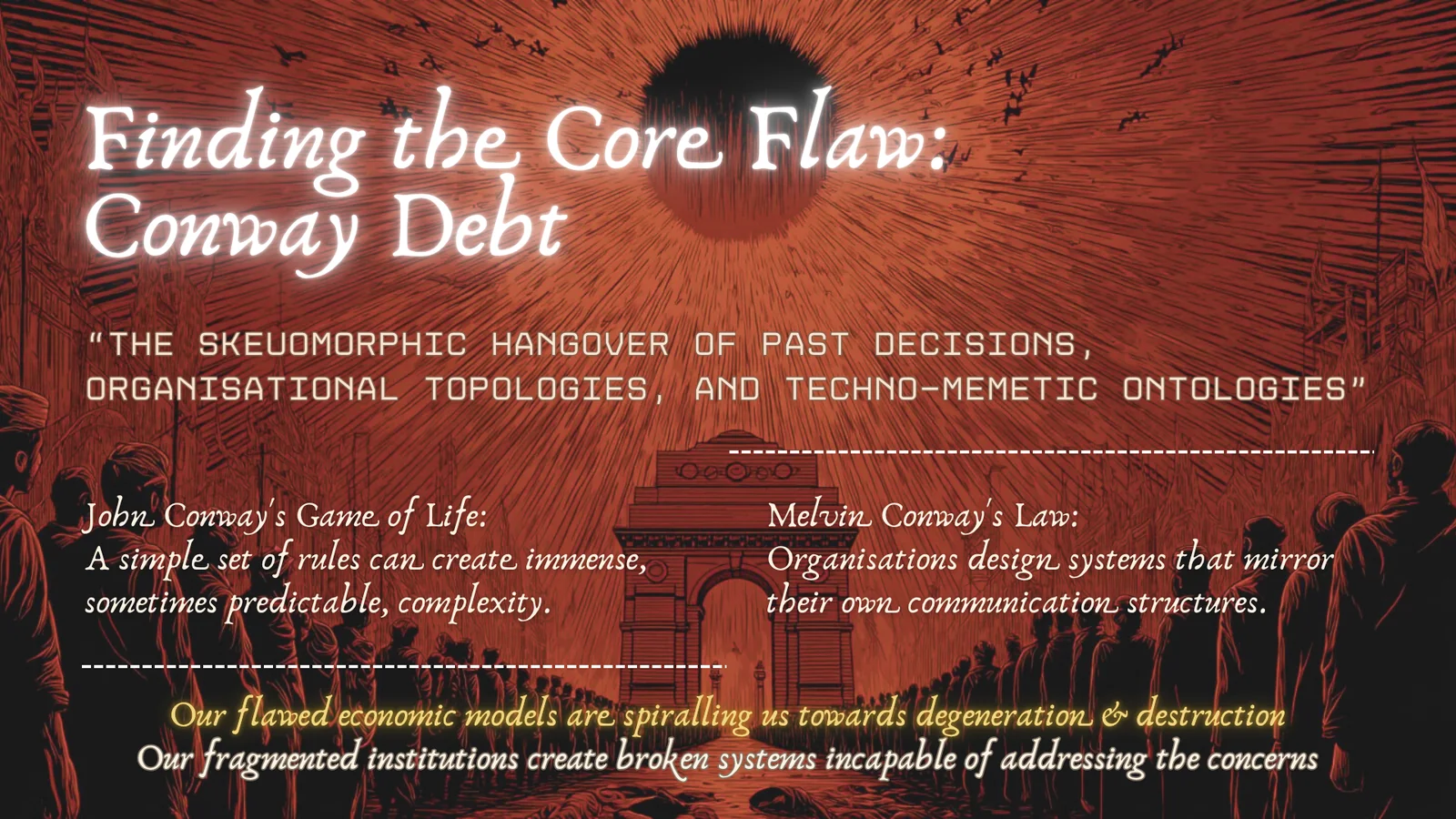
Conway Debt is what you get when Conway's Law (organisations produce artifacts that mirror their communication structure) operates across time under Game-of-Life-style persistence rules (once a glider is moving, it doesn't stop). The artifacts outlast the organisations. New organisations rebuild around them. The pathology compounds. The polycrisis isn't a list of problems — it is Pañca Ṛṇa unpaid in modern operational form, computing in the present like gliders that won't stop.
Two Conways, two ideas
Conway's Law (1968). Melvin Conway's observation, made about software systems: any organisation that designs a system will produce a design whose structure is a copy of the organisation's communication structure. If three teams build a compiler, you get a three-pass compiler. The hierarchy in the org chart shows up in the call graph of the code.
Conway's Game of Life (1970). John Conway's cellular automaton (no relation to Melvin) — played on an infinite grid with three rules: a live cell with two or three live neighbours stays alive; a dead cell with exactly three live neighbours becomes alive; everything else dies. From those three rules you get gliders, oscillators, spaceships, glider guns — patterns that persist and propagate indefinitely.
Now combine them
Every organisation a civilisation has ever built leaves a structural fingerprint on the artifacts it produces. The artifacts outlast the organisation. New organisations inherit the artifacts and unconsciously rebuild around them — the same way new code wraps around old APIs, the same way regulations layer on regulations, the same way a city's streets follow the cow paths of the village it was built over.
The result is Conway Debt — a compounding skeuomorphic hangover of every prior org chart, every ontology, every decision, every technopoly, computing in the present like gliders that won't stop.
Every new organisation rebuilds around them.
This is not only metaphor
Ivan Illich documented the social mechanism in the same historical era that systems thinkers were learning to see emergent patterns. In Tools for Conviviality, Medical Nemesis, and Deschooling Society, Illich showed that past a complexity threshold, institutions produce the inverse of their stated purpose. Medicine sickens. Schools un-educate. Transport immobilises. His concept of radical monopoly — one institutional form foreclosing all alternatives — is Conway Debt in operational form. Cars don't just compete with other transport; they make walking dangerous.
Joseph Tainter provides the archaeological dataset. In The Collapse of Complex Societies (1988), Tainter shows that civilisations rise by adding complexity to solve problems. Each new layer of administration, regulation, military, or infrastructure costs more than the last and solves less. Marginal returns on complexity eventually go negative. Then collapse — which, in his account, is often an adaptive simplification, not the end of the world. Rome didn't fall because of barbarians. Rome fell because the cost of maintaining its accumulated institutional skeuomorphs became harder to sustain than to shed.
The five Conway Debts the modern world is computing on
Each of these is a pattern that started somewhere specific, got encoded into institutional artifacts, and is still propagating through the present long after the org chart that produced it stopped being right.
1. Colonialism
Administrative, educational, legal, and epistemic structures designed for extraction-with-administration. The East India Company's bookkeeping conventions. Macaulay's education system. The late-nineteenth-century census categories. These artifacts are still computing — through university hierarchies, the language of governance, the deep assumption that "development" means convergence on Western institutional forms. The org chart was decommissioned in 1947. The gliders did not stop.
2. Capitalism-as-practised
Karl Polanyi named the move precisely in 1944: treating land, labour, and money as fictitious commodities they are not — pricing the priceable while making invisible whatever cannot be priced. The Dutch East India Company's joint-stock accountability glider has been computing since the early seventeenth century. Cognition and attention are now the fourth fictitious commodity, the disembedding repeating at a higher tier. We are watching, in real time, the enclosure of the AI commons that just opened.
3. Communism
State monopoly on power. Bureaucratic top-down planning. The suspicion of community as a coherent agent. The Soviet org chart is gone; the gliders are still in the welfare-state-as-only-care-economy assumption, in the framing of the household as residual to the market, in the idea that the only legitimate alternative to the market is the State.
4. Consumerism
The individual-as-consumer-only frame. Growth-without-rhythm. Advertising-as-cultural-substrate. René Girard names the engine — mimetic desire, we want what others want, amplified to industrial scale. The attention economy is industrialised mimesis. Engagement metrics are mimetic-desire amplifiers. Viral trends are mimetic contagion. Once the pattern is loaded into the substrate, it propagates.
5. Caste-as-colonially-frozen
A complex field of varṇa-jāti-kula-āśrama distinctions was further rigidified by colonial census and administrative categories, then often treated as if the colonial freeze-frame exhausted the older reality. Some post-colonial critique attacks a colonial artifact while believing it is attacking the whole pre-colonial reality — a double skeuomorph, a Conway Debt eating its own tail.
Each Conway Debt is Pañca Ṛṇa unpaid
The Indic frame names what modern accounting misses directly. The five civilisational obligations — Bhūta (ecology), Manuṣya (society), Pitra (household and lineage), Ṛṣi (knowledge and commons), Dev (governance) — are the ledger items that Conway Debts systematically erase.
- Colonialism is unpaid Manuṣya Ṛṇa and Dev Ṛṇa — a multi-generational default on social trust and on governance integrity.
- Capitalism-as-practised is unpaid Bhūta, Manuṣya, and Pitra Ṛṇa simultaneously — the ecological, the social, and the intergenerational, all externalised to a ledger that has no statute of limitations.
- Communism is unpaid Pitra and Dev Ṛṇa — the destruction of household-scale autonomy and the saturation of governance with a single monopolist.
- Consumerism is unpaid Ṛṣi Ṛṇa — the strip-mining of the knowledge and aesthetic commons for short-cycle extraction.
- Caste-as-colonially-frozen is unpaid Manuṣya Ṛṇa carried by a colonial artifact masquerading as the pre-colonial source.
The point is not which -ism is worse. The task is not to defeat any individual -ism. The task is to pay off Conway Debt across all five Ṛṇa simultaneously. No single ideology can do that — they are each the gliders, not the grid.
Why no single Western frame can solve its own Conway Debt
The Western literature has been naming this pathology in fragments for seventy years, each fragment getting closer to the bone. Allen Ginsberg saw it in 1955: Howl personifies industrial civilisation as Moloch, the Canaanite child-sacrifice god, the thing humans build that demands what humans love. Scott Alexander gave it a game-theoretic chassis in 2014: Moloch is the multipolar trap, rational individual action producing collectively worse outcomes than coordination would.
Nick Bostrom captured the endgame in Disneyland with no children — gleaming, optimised, maximally efficient, and no one home. Daniel Schmachtenberger named the integrating insight: the metacrisis is one upstream generator function, not a portfolio of crises.
Every one of these is a partial naming of what the Indic frame can treat as unified. Externalities equals unpaid Ṛṇa. Moloch equals anṛta, velocity without rhythm. The metacrisis equals Conway Debt. The relationship is not "Indic version of Western ideas," and it is not "Western proof of Indic truth." The older accounting grammar does not need permission; the newer fragments are useful because they make recurring truths legible to institutions trained in modern categories.
is that each carries only part of the accounting.
Goodhart's Law — when a measure becomes a target, it ceases to be a good measure — is the inevitable structural consequence of single-metric optimisation. The puruṣārtha framework (dharma, artha, kāma, mokṣa) is structurally Goodhart-resistant. The four hold each other in tension. No single one can be optimised in isolation. Pursue artha without dharma and you produce the modern economy. Sāmatvārtha is artha pursued in the tensioned fourfold.
The audit is already running
What is new in the 2020s is not the Conway Debt — that has been compounding for centuries. What is new is the auditor. AI is becoming capable enough to read much more of the grid at once — contracts, regulations, institutions, assumptions — and report what is actually circulating versus what is just running on momentum.
Whether the audit reveals the pathology or merely accelerates it depends on which substrate the audit is built against. Same technology. Different ledger. Different result. That is the design question underneath the work.