Pañca Ṛṇa. पञ्च ऋण — the five obligations
The civilisational ledger modern accounting cannot see — and the one any honest regenerative economics has to balance against.
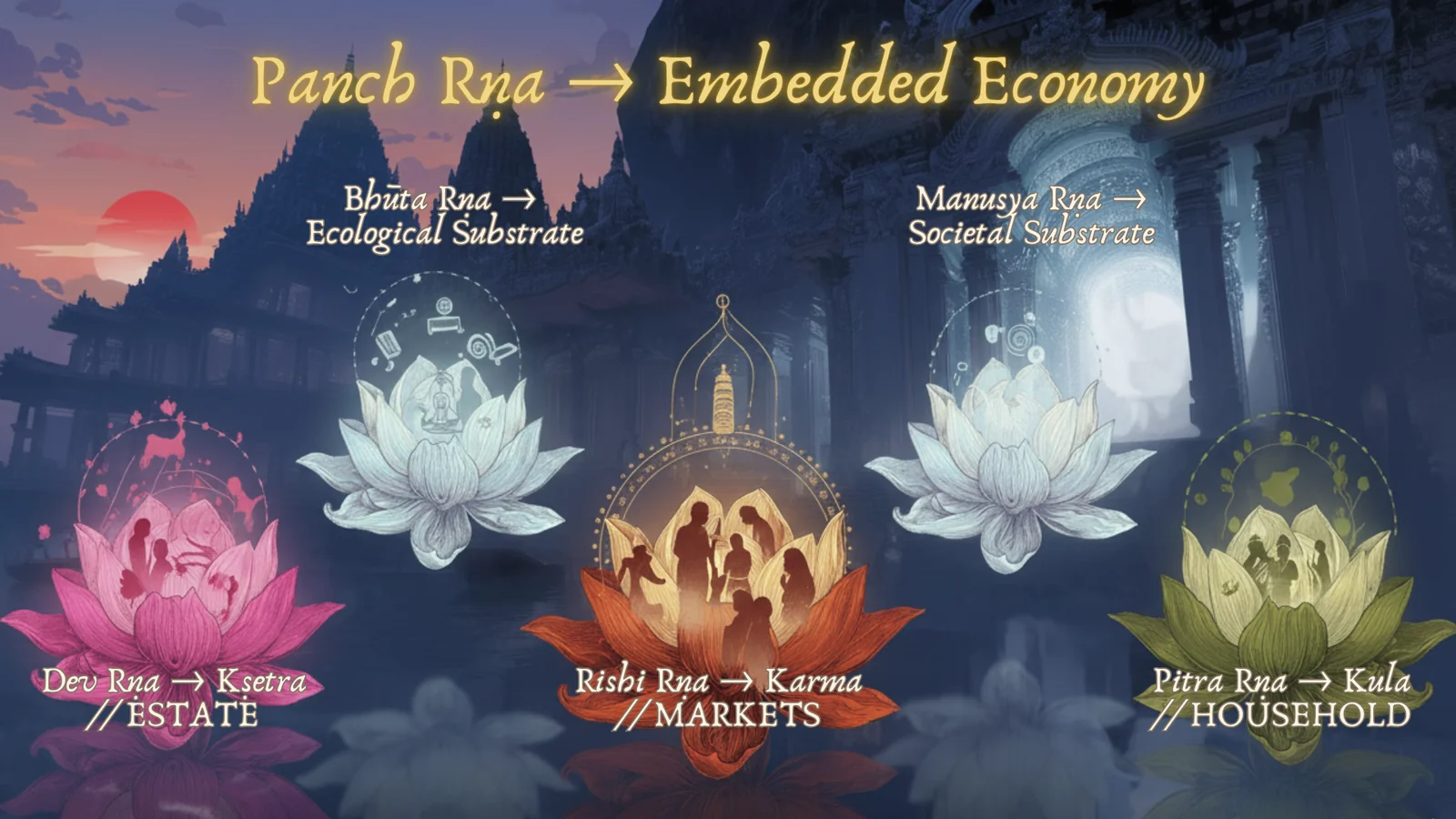
Pañca Ṛṇa is the Sāmatvārtha rendering of classical Indic obligation vocabulary into five ledger domains: Bhūta (earth), Manuṣya (society), Pitra (household and lineage), Ṛṣi (knowledge commons), Dev (governance). Where modern economics says "externalities," Pañca Ṛṇa says "unpaid obligations with no write-off." Where Doughnut Economics says "boundaries," Pañca Ṛṇa says "debts." The accounting is what the audit is built against.
The premise
Before there is policy, there is accounting. Every economic system rests on an unspoken chart of accounts. The ledger determines what counts as production, what counts as cost, what counts as value, and what counts as nothing at all.
The reason Western economics keeps slipping back into market-centric framing — even when its best practitioners explicitly try to embed markets in society and ecology — is that the underlying ledger does not hold the embedding. Externalities exist as accounting categories specifically because the ledger they fall outside of is too narrow.
The Indic ledger is wider. The wideness is the contribution.
The substrate: Ṛ → Ṛta → Ṛṇa
Pañca Ṛṇa sits inside a triadic spine. Ṛ (ऋ) is the root verb-sound — motion, the cosmological starting point. Ṛta (ऋत) is motion attained — rhythm, cosmic order as emergent coordination. Ṛṇa (ऋण) is civilisational debt, the obligation Ṛta generates. Where Ṛta is flowing rightly, no Ṛṇa accumulates. Where Ṛta is broken, Ṛṇa compounds.
Crucially: Ṛṇa has no write-off. You cannot default on cosmic obligation. You can only honour it or accumulate it. The world's multi-hundred-trillion-dollar debt regime, periodic sovereign defaults, and election-cycle farm-loan waivers — these are a category error. You cannot write off what is owed to the substrate that makes all borrowing possible.
that makes all borrowing possible.
The five obligations
| Ṛṇa | Domain | What modern accounting misses |
|---|---|---|
| Bhūta भूत — elements |
Earth, elements, ecosystems | Carbon is the least of it. Soil regeneration, water cycle integrity, biodiversity, the regenerative capacity of the biosphere itself. |
| Manuṣya मनुष्य — humans |
Fellow humans, society | Trust, reciprocity, civic health, the unmeasured labour of maintaining relationships across difference. |
| Pitra पितृ — lineage |
Household, lineage, intergenerational | Care work, child-rearing, elder care, the economy's unacknowledged foundation. Memory and continuity across generations. |
| Ṛṣi ऋषि — seer |
Knowledge, culture, commons | The intellectual inheritance. Everything IP law encloses and markets price without replenishing. |
| Dev देव — order |
Governance, higher order | Institutional integrity, regulatory wisdom, the sacred dimension of collective decision-making. |
Each obligation, in operational detail
Bhūta Ṛṇa — to the elements
The earth and its capacities — soil, water, atmosphere, biome. Modern accounting names some of this badly (carbon as a single flow) and the rest not at all (the regenerative capacity of the biosphere itself). Bhūta Ṛṇa is not about emissions targets. It is about whether the substrate that produces the economy continues to be capable of producing it.
Ecological economics (Daly, Hawken), planetary boundaries (Rockström), Doughnut Economics (Raworth) all approach Bhūta Ṛṇa. They name parts of it. They miss the obligation-grounding — they treat the boundary as external limit rather than debt owed. The boundary you can violate and pay for is rivalrous; the obligation you owe is not.
Manuṣya Ṛṇa — to fellow humans
The social fabric. Civic trust. Reciprocity across difference. The unmeasured labour of holding a society together — by professionals (community workers, mediators, teachers) and by everyone else (neighbours, friends, family). When social capital theorists (Putnam) measure declining civic engagement, they are measuring Manuṣya Ṛṇa accumulating.
Manuṣya Ṛṇa is the obligation defaulted on by every attention-economy product, every algorithmic feed engineered for engagement-over-truth, every workplace culture that treats relationship-maintenance as overhead.
Pitra Ṛṇa — to household and lineage
The household as primary economic unit, not residual to the market. Care work as economically productive activity, not unpriced background. Intergenerational lineage as continuity- carrier rather than nostalgia.
Pitra Ṛṇa is the most invisible to modern accounting. GDP does not count care; HR departments do not count it; investors do not count it. The parent raising children, the elder maintaining social fabric, the family member doing eldercare — these are the economy's foundation, not its externality. Default on Pitra Ṛṇa long enough and you get the demographic and mental-health signatures advanced economies are currently exhibiting.
Ṛṣi Ṛṇa — to knowledge and commons
The intellectual inheritance — language, mathematics, music, methods, scripture, science. Everything anyone alive today received without paying for, and which IP regimes systematically enclose without replenishing. The default on Ṛṣi Ṛṇa is happening right now, at industrial scale, as open-source software gets strip-mined by cloud providers and open-weight AI models get enclosed by fine-tuners who never contribute back.
Techno-Memetic Commons (TMC) is 2014P_'s operational response to Ṛṣi Ṛṇa: a reciprocity-enforced governance framework where derivative works on the commons must be contributed back, by construction.
Dev Ṛṇa — to governance and higher order
Institutional integrity. Regulatory wisdom. The sacred dimension of collective decision-making. Dev here does not translate as "god" in the Abrahamic sense — it names the ordering principle that makes collective coordination possible at all.
Dev Ṛṇa is the obligation defaulted on by every captured regulator, every revolving door between industry and oversight, every policy designed for the short electoral cycle, every erosion of the institutional fabric that future generations will inherit. When Acemoglu and Robinson distinguish inclusive from extractive institutions, they are measuring Dev Ṛṇa balance.
Why these five and not others
The fivefold is not arbitrary. It maps to the three Indic systems-thinking axes:
- Bhūta → Kṣetra (field — the substrate one acts within).
- Manuṣya → Karma (action — what one does and how it ripples).
- Pitra, Ṛṣi, Dev → Kula (lineage — the embedded carriers of household, knowledge, and order across time).
Where the Western literature has tried to expand the economic frame, it has typically added one or two axes. Polanyi added embedding (a partial Manuṣya move). Raworth added planetary boundaries (a partial Bhūta move). Mariana Mazzucato added value-creation versus value-extraction (a partial Dev move). Pañca Ṛṇa is the integrated five.
No single one can be optimised in isolation.
Goodhart-resistance by construction
Goodhart's Law — when a measure becomes a target, it ceases to be a good measure — is the inevitable consequence of single- metric optimisation. Carbon credits get gamed. Engagement metrics decouple from satisfaction. GDP decouples from welfare. Any single-axis ledger is structurally Moloch-friendly.
Pañca Ṛṇa is structurally Goodhart-resistant. The five obligations are interdependent. You cannot pay off Bhūta Ṛṇa by defaulting on Manuṣya Ṛṇa (industrial-scale extraction financed by social-fabric exploitation). You cannot pay off Ṛṣi Ṛṇa by defaulting on Pitra Ṛṇa (an "open knowledge" project that burns out the household economies of its contributors). Each obligation can only be honoured in tension with the others. This is the same Goodhart-resistance the puruṣārtha framework (dharma, artha, kāma, mokṣa) achieves through tensioned-fourfold construction.
How Pañca Ṛṇa relates to Conway Debt
Conway Debt is what accumulates when Pañca Ṛṇa is systematically defaulted on. The five canonical Conway Debts the modern world carries — colonialism, capitalism- as-practised, communism, consumerism, caste-as-colonially-frozen — are each Pañca Ṛṇa unpaid in modern operational form:
- Colonialism — unpaid Manuṣya Ṛṇa and Dev Ṛṇa, computing through the inherited administrative and epistemic structures of extraction-with-administration.
- Capitalism-as-practised — unpaid Bhūta, Manuṣya, and Pitra Ṛṇa simultaneously — the ecological, the social, and the intergenerational, all externalised to a ledger that has no statute of limitations.
- Communism — unpaid Pitra and Dev Ṛṇa — the destruction of household-scale autonomy and the saturation of governance with a single monopolist.
- Consumerism — unpaid Ṛṣi Ṛṇa — the strip-mining of the knowledge and aesthetic commons for short-cycle extraction.
- Caste-as-colonially-frozen — unpaid Manuṣya Ṛṇa carried by a colonial artifact masquerading as the pre-colonial source.
The task is not to defeat any individual -ism. The task is to pay off Conway Debt across all five Ṛṇa simultaneously.
Operationally — how to ledger Pañca Ṛṇa
A practical Pañca Ṛṇa accounting is the chart of accounts the audit is built against. Rough mapping to existing instrumentation:
- Bhūta — carbon, water, soil, biodiversity flows (existing ecological accounting), plus regenerative-capacity proxies (Drawdown ranking, regenerative agriculture metrics, Living Planet Index).
- Manuṣya — civic trust indices (Edelman, OECD), social capital proxies (Putnam-style), volunteer-economy time-use surveys.
- Pitra — time-use accounting for unpaid care work (already standardised by some national statistics agencies), intergenerational consumption ratios, ecological footprint per generation.
- Ṛṣi — open-source contribution flows, commons-vs-enclosure ratios in given fields, knowledge-spillover metrics, public-domain expansion rates.
- Dev — institutional integrity indices (Worldwide Governance Indicators), regulatory-capture metrics, civic infrastructure quality.
The instruments the Sāmatvārtha architecture proposes — Unified Tax Credit (recognising care, regeneration, and civic contribution as fiscally accounted productive activity), Sovereign Tax Bond (multi-currency tokenisation of fiscal and monetary policy), Golden Fee (Pigouvian-with- Goodhart-resistance pricing) — are the policy instruments that make Pañca Ṛṇa ledgerable inside contemporary fiscal architecture.