Sāmatvārtha सामत्वार्थ — prosperity in rhythm
A working architecture for regenerative economy — built at the intersection of complexity science, Indian philosophical vocabulary, and venture execution.
Sāmatvārtha is a proposed operating frame for a regenerative economy — prosperity (artha) sought in rhythm (sāmatva). It rests on a triadic spine (Ṛ → Ṛta → Ṛṇa), an accounting system (Pañca Ṛṇa — the five obligations), and an executing architecture (Stack / Interchain / Network State). It is the answer being assembled to the question of which frame gets loaded onto the AI substrate before the old one finishes collapsing.
The moment
Three things are happening at once. The old frame is failing — climate breakdown, institutional decay, attention economies degrading the substrate they extract from, a generation that knows something is wrong and lacks the vocabulary to name it. A new technical substrate is emerging — artificial intelligence, digital public infrastructure, distributed protocols, programmable money. And the Indian intellectual and institutional context offers live vocabularies of obligation, rhythm, and embedded economy strong enough to contest the default extractive frame.
India matters here as a live build context, not as museum or mystique: Sanskritic and bhāratīya vocabularies, digital public infrastructure, MSME rails, and dense household-enterprise forms are all active materials. The convergent question of the decade: which frame gets loaded onto the new substrate before the old one finishes collapsing? Sāmatvārtha is the answer being assembled.
This is the Lindy / Sanatana claim in operational language: not that modern Western theory grants permission to an older wisdom, but that durable truths keep being rediscovered under new names when civilisations hit the same substrate constraints. The work is to recognise the recurrence without surrendering the original vocabulary or turning it into decorative identity.
Before there is policy, there is metaphysics. Every economic system rests on an unspoken cosmology.
The substrate: Ṛ → Ṛta → Ṛṇa
Sāmatvārtha uses a triadic Sanskrit spine. Ṛ (ऋ) is a root verb-sound glossed through movement: to move, to rise, to set in motion. The frame treats reality as process before object, which makes it resonant with process philosophy, complexity science, and systems thinking without pretending those traditions are the same thing.
Ṛta (ऋत) — Ṛ plus kta — motion attained, rhythm achieved. The cosmic order not as imposed law but as emergent rhythm. Ṛta is what equilibrium pretends to be and isn't. Static balance is dead. Living rhythm is alive. The distinction is non-trivial — it is the difference between a frozen lake and a flowing river.
Ṛṇa (ऋण) — obligation, debt, that which is owed. Crucially, Ṛṇa has no write-off. You cannot default on cosmic obligation. You can only honour it or accumulate it. The world's multi-hundred-trillion-dollar debt regime, periodic sovereign defaults, election-cycle farm-loan waivers — these are a category error. You cannot write off what is owed to the substrate that makes all borrowing possible.
The accounting: Pañca Ṛṇa
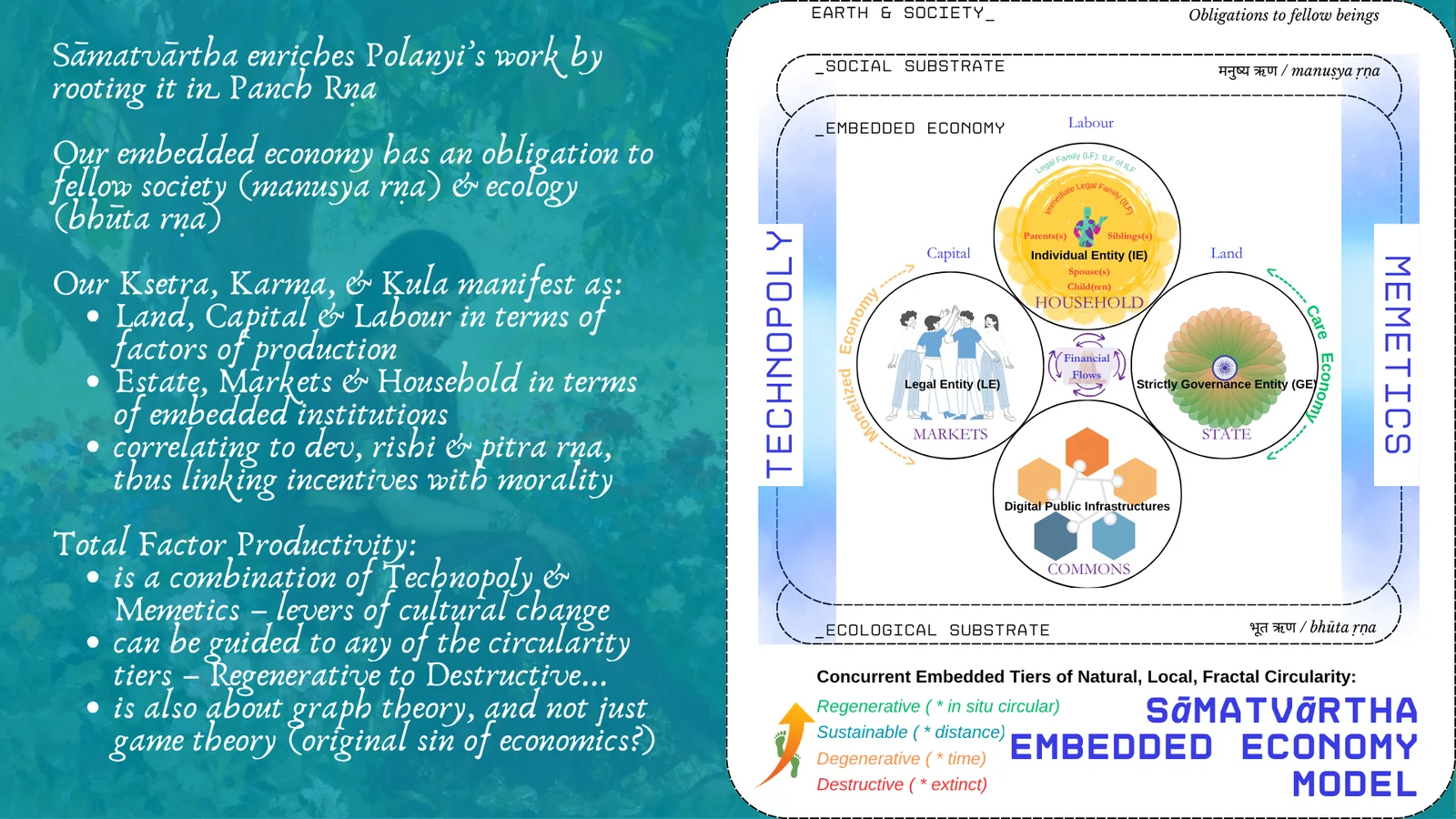
The Sāmatvārtha operationalisation of Ṛṇa into five ledger domains. Every person, household, institution, and community sits inside obligations to ecology, society, lineage, knowledge, and governance. Modern economics recognises few of these as ledger items.
| Ṛṇa | Domain | What modern accounting misses |
|---|---|---|
| Bhūta | Earth, elements, ecosystems | Carbon is the least of it. Soil, water, biodiversity, the regenerative capacity of the biosphere itself. |
| Manuṣya | Fellow humans, society | Trust, reciprocity, civic health, the unmeasured labour of maintaining relationship. |
| Pitra | Household, lineage, intergenerational | Care work, child-rearing, elder care, the economy's unacknowledged foundation. |
| Ṛṣi | Knowledge, culture, commons | The intellectual inheritance. Everything IP law encloses and markets price without replenishing. |
| Dev | Governance, higher order | Institutional integrity, regulatory wisdom, the sacred dimension of collective decision-making. |
Externalities. Intergenerational equity. Knowledge commons. Civic trust. These are partial translations of what Pañca Ṛṇa names directly. Read the full Pañca Ṛṇa frame →
The diagnosis: Conway Debt
The metacrisis is not a list of problems. It is the symptom of a single underlying pathology. Conway's Law — organisations produce artifacts that mirror their own communication structure. Conway's Game of Life — simple local rules produce complex emergent persistent patterns; once a glider is moving, it persists.
Combine them: every organisation a society has ever built leaves a structural fingerprint on the artifacts it produces. The artifacts outlast the organisation. New organisations inherit the artifacts and unconsciously rebuild around them. The result is Conway Debt — a compounding skeuomorphic hangover of every prior org chart, every ontology, every decision, every technopoly, computing in the present like gliders that won't stop.
The specific Conway Debts the modern condition carries — colonialism, capitalism-as-practised, communism, consumerism, caste-as-colonially-frozen — are each Pañca Ṛṇa unpaid in modern operational form. Read the full Conway Debt frame →
The architecture: three substrates
The world has three concurrent substrates, each carrying its corresponding obligations.
The ecological substrate
The earth, elements, energies, beings. Bhūta Ṛṇa. Elinor Ostrom's Nobel-recognised fieldwork showed that commons are not tragic by default. They become tragic under certain rule failures, capture patterns, and unmanaged extraction. Her eight design principles are not theoretical preferences — they are empirically grounded conditions under which commons can survive across generations.
The social substrate
Fellow humans, community, civic fabric. Manuṣya Ṛṇa. Timothy Morton's hyperobjects — entities massively distributed in time and space that exceed individual cognition — explain why this substrate is perceptually difficult. The metacrisis is hyperobject-shaped. Sāmatvārtha's network-state architecture is itself hyperobject-shaped. This is a feature.
The embedded economic substrate
The institutional layer. Composed of three sub-elements: Estate (the State as honoured institution, not monopoly), Household (primary economic unit, not residual to the market), and Markets (one honoured mechanism among others, not the central god of allocation). Karl Polanyi identified the embedded economy in 1944; Kate Raworth's Doughnut Economics maps it. Sāmatvārtha reads the same terrain through obligation-grounding rather than through limits alone.
In Sāmatvārtha, they are obligations owed.
The build: 2014P_
If Sāmatvārtha is the thesis, 2014P_ is the executing instrument — an integrated venture studio operating through four levers: Business (new venture models), Technology (DPIs and commons), Content (narrative and memetics), Compliance (policy and governance). Three interconnected DPI strata.
The Sāmatvārtha Stack
For governments. Techno-legal process reforms as Digital Public Infrastructure, modelled on India Stack but designed for the regenerative transition. The interface with the State.
The Sāmatvārtha Interchain
For enterprises. Open, composable, interoperable DPIs that make regenerative nano-MSMEs as easy to start and scale as a Shopify store. TMC-governed throughout — unenclosable by construction.
The Sāmatvārtha Network State
For people. A federated community of Sutradhaars — thread-holders, the weavers of scenes in classical Sanskrit drama — who carry the Sāmatvārtha thread and execute across the Stack, the Interchain, and the ground.
The scaling sequence
1,000 Sutradhaars → 10,000 entrepreneurs → one million proprietors. The first wave of Adventures is already in motion — Intercamp (labour and community), KYRM (capital and trust), ForrestFarms (land and production), Asmakam (a sthala-based community demonstration), KiranaCulture (federated quick-commerce), AnviKriti (open education), OMAHARY (open compute and intelligence stack), BakedSamosa (content economy index), and more.
If you must translate to the language of the current zeitgeist: 10,000 entrepreneurs each earning ₹12L a year, at an 8× earnings multiple, imply roughly ₹9,600 Cr — the same order of arithmetic as a unicorn, distributed across ten thousand families. The federated unicorn is the same order of arithmetic, distributionally inverted; the metric is used as a translation device, not accepted as the master value. Read the federated unicorn argument →
AI is the audit
One intervention cuts to the heart of where AI-era political economy is going. Silicon Valley's response to AI-driven labour displacement is Universal Basic Income — rent paid by the AI-owning class to the displaced class, mediated by the state. The story is told as compassion. In this thesis, it is structurally Yayati at system scale — the present consuming the future's inheritance, framed as duty.
The Sāmatvārtha alternative restores the accounting. Care work, ecological stewardship, civic participation are economically productive activities that current accounting renders invisible. Restore the accounting and the apparent need for UBI dissolves. The AI productivity dividend flows into regenerative substrate rather than rent-preserving extraction. Read the "AI is the audit" frame →
The inheritance
Sāmatvārtha does not arrive in a vacuum. It draws from a contested, living field of Indian intellectual work: Voice of India (Sita Ram Goel, Ram Swarup), Rajiv Malhotra, J Sai Deepak, Brhat (Raghav Krishna, Amritanshu Pandey, Pankaj Saxena), Dharampal, Subhash Kak, Meenakshi Jain, and others. This is a working bibliography, not a purity claim.
The Codex then places this beside adjacent complexity-science and social-theory work — Elinor Ostrom (commons design), Karl Polanyi (embedded economy), Yuk Hui (cosmotechnics), Iain McGilchrist (hemispheric attention), Karl Friston (free energy principle), Joseph Tainter (complexity collapse), Ivan Illich (counterproductivity), Daniel Schmachtenberger (metacrisis), Kate Raworth (planetary boundaries). The point is not West versus India, nor Western validation of Indic material; it is disciplined comparison around recurring substrate truths, with sources named and neither side flattened.
It is a translation and execution project.
The invitation
Sāmatvārtha is not a movement to join as audience. It is an architecture to build as Sutradhaar — thread-holder, the one who carries the Sāmatvārtha thread into execution.
- If you build companies — pick a primitive (capital, labour, land, production, consumption, education, software, hardware). Build an Adventure within it. Federate via open playbook.
- If you architect policy — engage the Stack. The Pañca Ṛṇa accounting framework gives you an obligation structure that outlasts any electoral cycle.
- If you allocate capital — engage the Investment Studio. Mission-aligned capital architecture, patient capital structured for distributed return.
- If you build technology — the Interchain needs engineering at every level. The substrate question is not what you can build but which substrate you are building on.
- If you write, film, broadcast, post — install the vocabulary. Make Ṛṇa-accounting legible. Make Conway Debt visible. Make federated regeneration desirable.
- If you are a householder, a parent, a citizen — Pañca Ṛṇa is portable. Start accounting for what you owe. The accounting begins at home.
The civilisational moment is now. The old frame is failing. The new substrate is being laid. The Sutradhaars are gathering. The thread is being woven. Will you carry it?