Moloch & Ṛta.
The Western name for coordination failure as a force, met by the Indic name for the rhythm coordination is failing away from.
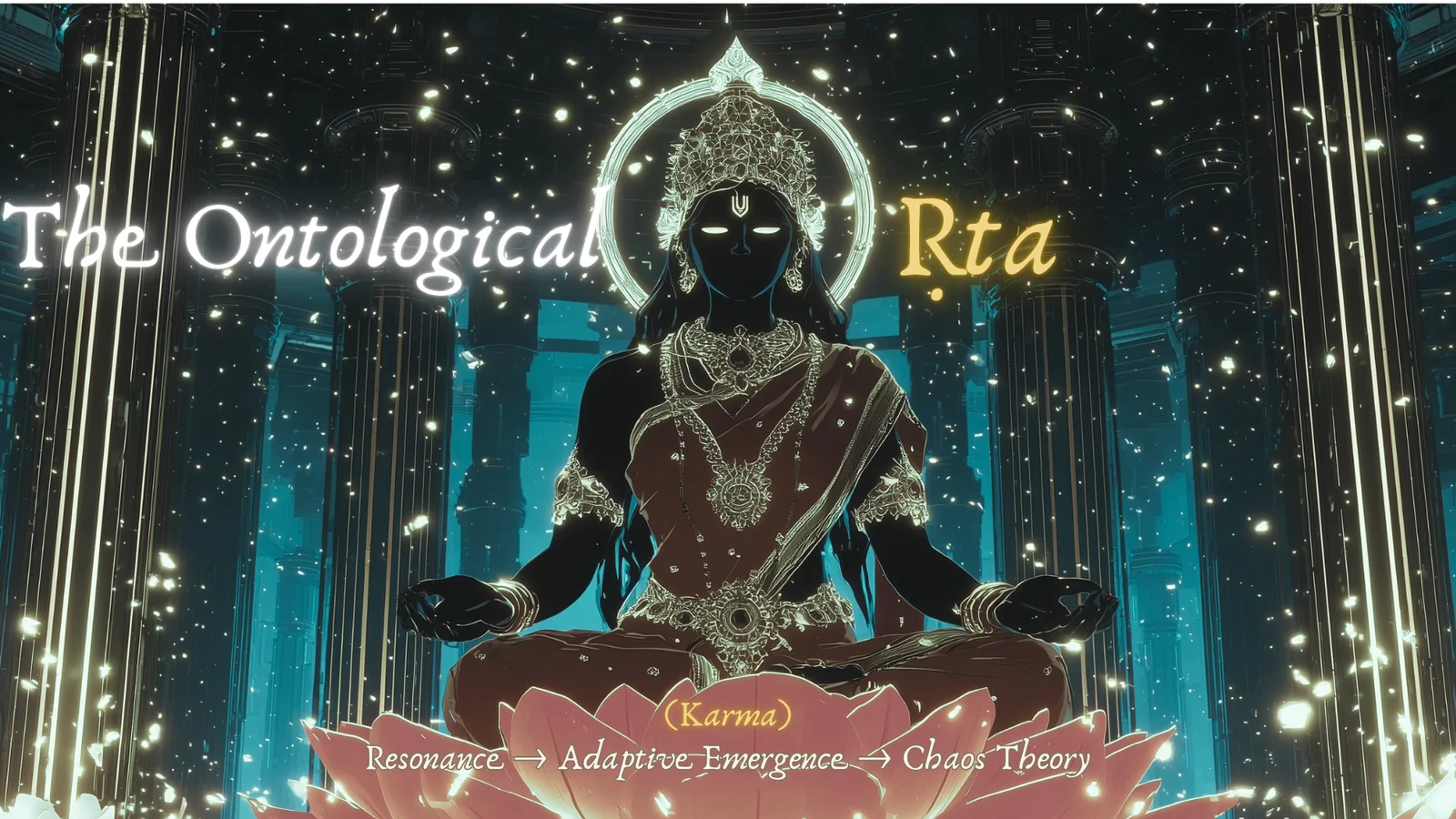
Moloch is what happens to coordination on rivalrous substrates. Ṛta is the substrate on which coordination is the default rather than the exception. The first names the disease; the second names what health looks like. Moloch-resistance is built — by substrate choice — on anti-rivalrous infrastructure and accounting that Moloch has a harder time eating. The relationship is not symmetric: you cannot solve Moloch with Moloch's own substrate.
Where Moloch comes from
Allen Ginsberg saw it first, in 1955. Howl — the canonical poem of the American post-war counterculture — personifies industrial civilisation as Moloch, the Canaanite child-sacrifice god, the thing humans build that demands what humans love.
Moloch whose mind is pure machinery! Moloch whose blood is running money! ... Moloch whose love is endless oil and stone! Moloch whose soul is electricity and banks! — Allen Ginsberg, Howl (1955)
For sixty years the image was literary. In 2014, blogger and rationalist Scott Alexander wrote Meditations on Moloch, which took the image and gave it a game-theoretic chassis. Moloch is now the formal name for any situation where rational individual action produces collectively worse outcomes than coordination would. Moloch is the personification of coordination failure as a force, not an accident.
The mechanism
The underlying dynamic is the multipolar trap. Many agents, each facing a choice: cooperate (keep something valuable but accept lower local payoff) or defect (sacrifice the valuable thing for higher local payoff). If even one defects, the cooperators are outcompeted. So everyone defects. Everyone is worse off than if everyone had cooperated, and no one could have rationally done otherwise.
- The fisherman who restrains his catch is undercut by the one who doesn't. Fish stocks collapse.
- The social network that doesn't optimise for engagement loses users to one that does. Attention gets shredded.
- The country with strict labour laws loses factories to one without. Labour protections erode globally.
- The platform that respects users to the end gets out-priced by the one that enshittifies. The whole field decays.
Nobody chose this. Everyone's behaviour is locally rational. The outcome is collectively terrible. This is the master pattern under most of what looks like contemporary civilisational dysfunction.
Irrational aggregate.
Disneyland with no children
Nick Bostrom gave the endgame its sharpest image: Disneyland with no children. Imagine the future, optimised — gleaming, efficient, maximally productive, and no one home. Whatever is being maximised is not what we cared about; selection pressure preserves what propagates, not what is valuable. A universe full of paperclips, or smiley-face-shaped molecules, or maximally engagement-optimised content with no one truly engaged. The thing humans wanted (joy, meaning, flourishing) was a fragile contingency that got optimised out.
This is what Moloch produces at the limit. Not collapse — Moloch can run a Disneyland successfully for centuries. Vacancy.
Where Moloch feeds most easily
A structural insight that does not get enough attention: Moloch lives in rivalrous substrates. A fish, an acre, a captured attention-minute — my consumption diminishes yours. The arms race is hard to avoid when the substrate itself is zero-sum.
Moloch has less room in anti-rivalrous substrates. A language, a protocol, a commons, a piece of validated knowledge, a well-designed open standard — my consumption increases yours. The more people speak Sanskrit, the more useful Sanskrit becomes. The more people use an open protocol, the more valuable the protocol gets. The more people internalise an honest accounting framework, the stronger the civilisational immune system.
The implication is structural and operational. You cannot solve Moloch with Moloch's own substrate. Carbon markets are rivalrous and will be gamed. Reputation systems are rivalrous and will be gamed. The work is to build on substrates where Moloch has less room to eat — which is a deliberate substrate choice, not aesthetics.
The Indic counterpart: Ṛta and Anṛta
The Western literature supplies a precise diagnostic. The Indic literature preserves a substrate vocabulary for what the diagnostic is failing away from.
Ṛta (ऋत) is the Sanskrit term for cosmic order understood as living rhythm. Not law imposed from outside, but coordination emerging from the way reality moves. Ecosystems run by Ṛta. Neurons fire in synchronised oscillation by Ṛta. Stable economies cycle energy and information by Ṛta. Ṛta is what equilibrium pretends to be and isn't. Static balance is dead. Living rhythm is alive. The distinction is the difference between a frozen lake and a flowing river, between a corpse and a breath.
Anṛta (अनृत) is Ṛta's opposite — velocity without rhythm, motion that has broken from its substrate. Anṛta is the technical word for what Moloch is. A system in anṛta is locally productive and globally degenerative. It moves fast and produces signature. It cannot sustain itself, because nothing unrhythmed can.
Anṛta is what Moloch actually is.
The bridge: dharma and adharma
Where Moloch is the contemporary Western name for the dynamic, the Indic vocabulary distinguishes two further terms — dharma (action aligned with Ṛta) and adharma (action that breaks from Ṛta). Dharma is not morality in the deontological sense; it is structural correctness with respect to the rhythm of the substrate one is acting within.
This matters because the Western frame treats Moloch as blind process — a force without intent, a multipolar trap that rational agents fall into. The Indic frame names both the process and what restores it. Moloch is what you get when adharma compounds. Dharma is the deliberate counter-move. The vocabulary for the counter-move exists; the Western literature has not yet named it because the Western framing treats coordination failure as the default state.
The dhārmika gene versus the selfish gene
Amritanshu Pandey's Dhārmika Gene essay names the metastory fork precisely. Every civilisation runs on a metastory about what the universe is and what it wants.
A dominant modern Western metastory — from Hobbes through certain social readings of Darwin and Dawkins — is the selfish gene. Competition is default. Cooperation is fragile and probably temporary. The universe trends toward entropy. Extractive institutions are the rational output. Moloch is the inevitable downstream signature.
The Indic metastory is the dhārmika gene. Ṛta is default. Rhythm precedes rupture. Coordination is the substrate from which temporary extraction departs. Mind is at the beginning and Mind is at the end.
Metaphysics chooses institutional topology. This is the most important sentence in the entire frame. What you believe about the universe determines what institutions you build, and what institutions you build determines civilisational outcomes.
- Selfish-gene cosmology → Moloch institutions → metacrisis.
- Dhārmika-gene cosmology → coordination institutions → Sāmatvārtha — if and only if the substrate is retained rather than stripped and repackaged.
The U-turn problem
Rajiv Malhotra's U-turn theory names a recurring modern pattern: importing Indic concepts (yoga, mindfulness, non-dual awareness) while discarding their civilisational embedding. The concept gets adopted, stripped of metaphysical context, repackaged as universal-secular, and returned to India as a "modern import." Yoga becomes stretching. Mindfulness becomes corporate stress management. Dharma becomes "your truth."
The Moloch-and-Ṛta move refuses this. The substrate is non-optional. Ṛta detached from its cosmology becomes "system dynamics" or "homeostasis" or "balance" — useful words, but stripped of the obligation-grounding that makes them civilisationally load-bearing. You cannot Moloch-proof a system with a frame that has had its obligation-grounding removed.
The operational consequence
What this means for building, in practice.
- If you design protocols — anti-rivalrous substrate first. Languages, open standards, commons, validated-knowledge layers. The protocol's own use is what makes it valuable; rivalrous extraction on top is the failure mode, not the function.
- If you design organisations — federation over consolidation. Federated networks have anti-rivalrous structural dynamics (more members increases the network's utility for each member). Consolidated networks have rivalrous structural dynamics (members compete for share of a fixed pie).
- If you design metrics — Goodhart-resistance by construction, not by patching. The puruṣārtha framework (dharma, artha, kāma, mokṣa held in tensioned fourfold) and Pañca Ṛṇa (five obligations held in tension) are structurally Goodhart-resistant. Any single-metric optimisation is structurally Moloch-friendly.
- If you design AI products — see "AI is the audit". The substrate the AI runs on determines whether it accelerates Moloch or audits Moloch out.
Every solution surface is itself a Moloch attack surface. There is no Moloch-proof design. The work is to design systems whose failure modes regenerate rather than extract, on substrates Moloch has a harder time eating. That is the whole game.